Learning Outcomes
This article examines Newton hearings in sentencing, including:
- The circumstances in which a Newton hearing is required following a guilty plea, how to identify a material factual dispute, and when a judge is likely to refuse a hearing as unnecessary.
- The procedural steps for initiating a Newton hearing, drafting and challenging a written basis of plea, and ensuring disputed and agreed facts are clearly defined for efficient case management.
- The respective roles and responsibilities of prosecution, defence, judge, and witnesses during the hearing, including duties of disclosure, tactical considerations, and practical advocacy points relevant to SQE1 problem questions.
- The allocation of the burden and standard of proof in relation to disputed aggravating facts, what happens if neither account is accepted, and how judges reach reasoned findings on the evidence.
- The impact of Newton hearing findings on sentencing outcomes, covering guideline categories, aggravating and mitigating factors, statutory minima, and the way proven or unproven facts shift the sentencing range.
- The effect of a contested hearing on credit for a guilty plea, including when credit may be reduced or withdrawn and how candidates should analyse plea credit in SQE-style scenarios.
SQE1 Syllabus
For SQE1, you are required to understand Newton hearings in sentencing, with a focus on the following syllabus points:
- Circumstances requiring a Newton hearing post-guilty plea.
- Procedure for resolving factual disputes in sentencing, including submission and acceptance of a basis of plea.
- Role and operation of the court in resolving disputes of fact, with reference to case management and pre-trial preparation.
- Burden and standard of proof in Newton hearings.
- Application and effect of sentencing guidelines and statutory factors based on the court’s findings.
- The practical implications for sentence calculation, aggravation/mitigation, and credit for guilty pleas, especially where a Newton hearing results in rejection of the defendant’s account.
Test Your Knowledge
Attempt these questions before reading this article. If you find some difficult or cannot remember the answers, look more closely at that area during your revision.
-
In which situation is a Newton hearing most likely to be required?
- a) When a defendant pleads not guilty and disputes the prosecution's evidence.
- b) When a defendant pleads guilty but disagrees with the prosecution about facts affecting the seriousness of the offence.
- c) When the prosecution wishes to introduce new evidence after conviction.
- d) When the defence wishes to appeal against the sentence imposed.
-
Who bears the burden of proof in a Newton hearing regarding disputed aggravating facts?
- a) The defendant, on the balance of probabilities.
- b) The prosecution, on the balance of probabilities.
- c) The defendant, beyond reasonable doubt.
- d) The prosecution, beyond reasonable doubt.
-
True or False: A Newton hearing is conducted before a jury.
-
What is the primary purpose of a Newton hearing?
- a) To determine the defendant's guilt or innocence.
- b) To decide on the admissibility of evidence.
- c) To establish the correct factual basis for sentencing.
- d) To hear mitigation from the defendant.
Introduction
Defendants who plead guilty to criminal charges typically expect sentencing to follow swiftly, based on facts that are largely agreed between the prosecution and defence. Yet not all guilty pleas resolve disputes concerning the circumstances of the offending conduct. Where the parties fundamentally disagree on facts that could significantly alter sentence severity—such as the use of violence, presence of a weapon, level of participation, or other aggravating or mitigating elements—the court must resolve these disputes to ensure sentence is properly calibrated. The process for judicial resolution of disputed facts post-guilty plea is called a Newton hearing, following the authority of R v Newton [1983] 77 Cr App R 13.
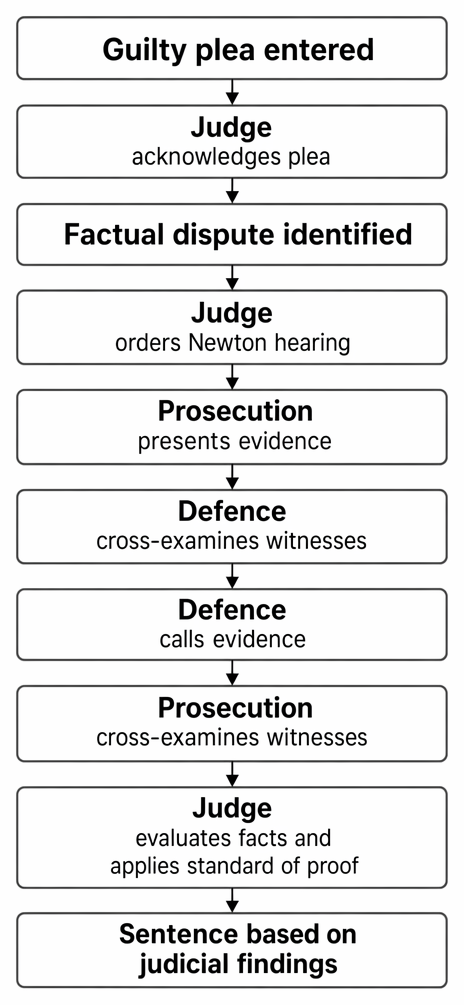
The procedure in a Newton hearing following a guilty plea extends from identification of the factual dispute to sentence on judicial findings.
Key Term: Newton Hearing
A court procedure, post-guilty plea, used to determine material factual disputes between prosecution and defence which affect the sentence imposed.
Newton hearings are necessary to maintaining fairness and proportionality in sentencing, ensuring that sentences are passed based only on proven facts, and not untested assertions. They provide a formal mechanism to test contested evidence, determine which version of events should be accepted, and direct the consequences for sentence. Proper understanding of their scope, process, and implications is essential for legal practitioners and for SQE assessments concerning criminal practice.
Test Tip: In SQE-style questions on Newton hearings, identify the legal test, the triggering fact, and the consequence before choosing between similar answer options.
Exam Warning: Do not rely on a familiar phrase from Newton hearings alone; check whether the facts satisfy every condition, exception, and timing requirement.
When is a Newton Hearing Necessary?
The necessity for a Newton hearing arises only if, after a defendant pleads guilty, a material dispute exists between the parties’ factual versions, and this dispute, if resolved, could materially affect the sentence imposed. Irrelevant or trivial differences do not warrant a hearing; the dispute must be substantial enough that resolving it will impact the sentencing bracket, the application of relevant guidelines, or statutory aggravating or mitigating factors.
Key Term: Factual Dispute
A disagreement between the prosecution and defence as to specific factual circumstances relating to the commission of an offence post-guilty plea, potentially requiring judicial resolution prior to sentencing.
Minor disagreements (for example, the precise time or inconsequential details not affecting seriousness or culpability) will typically be resolved by the judge accepting the defendant’s version or deciding the issue is immaterial. However, if the factual difference could increase or reduce the sentence—for instance, introducing a statutory aggravating factor, altering the assessment of harm or culpability, or affecting eligibility for mandatory minimums—the court must settle the dispute.
Examples of material factual disputes include:
- Whether a weapon was used in the commission of violence.
- The degree of harm inflicted on a victim.
- The value or nature of property taken.
- Whether threats or force were employed.
- The extent of defendant’s involvement in joint enterprises.
Courts are required to consider not just the facts themselves, but also the implications for sentencing categories or ranges. The threshold is whether the disputed facts could result in a more or less severe sentence.
The judge determines whether a Newton hearing is warranted by considering:
- The seriousness and relevance of the factual dispute.
- The likelihood that resolving the dispute would affect the sentence imposed.
- Whether sentencing guidelines hinge directly on resolution of the disputed facts.
The Basis of Plea
Where a defendant wishes to plead guilty but contests the prosecution version of relevant facts, the defence commonly submits a written basis of plea. This document sets out the factual elements admitted and those disputed. Its primary function is to clarify the defendant’s factual admissions, focus the area of dispute, and reveal whether sentencing can proceed without a Newton hearing.
Key Term: Basis of Plea
A written document in which the defence sets out the factual context in which the defendant admits guilt, distinguishing between facts accepted and facts disputed, especially where these differ from the prosecution's account.
The prosecution assesses the basis of plea and may:
- Accept it, allowing sentencing to proceed on the defendant’s version.
- Reject it, prompting the need for a Newton hearing if the disputed facts are material.
It is important for both parties to cooperate and specify clearly which facts are not accepted and why—the court must be able to identify the precise issues before determining whether a full hearing is needed. Standard case management forms require parties to indicate areas of dispute and any undisputed facts, ensuring clarity from the outset.
If the prosecution accepts the basis of plea, this will form the basis for sentence. If not, the judge must decide if the factual dispute is sufficiently material to sentence to justify a Newton hearing.
Worked Example 1.1
David pleads guilty to Assault Occasioning Actual Bodily Harm (ABH). The prosecution alleges David kicked the victim repeatedly while they were on the ground, significantly aggravating the seriousness. David admits punching the victim once but denies any kicking. His basis of plea reflects this, and the prosecution rejects it.
Answer:
The dispute—kicking versus a single punch—is material to the seriousness and likely sentence. The court should order a Newton hearing. The prosecution bears the burden to prove the kicking beyond reasonable doubt. If proven, David will be sentenced on that basis; if not, sentencing will be based on David’s version.
Worked Example 1.2
Simon pleads guilty to burglary. The prosecution claims Simon broke in by smashing a window, ransacked rooms, soiled carpets, and stole valuables. Simon admits entering through an open window, denies causing damage or soiling, and took only a small radio.
Answer:
The differences significantly affect the assessment of harm, loss, and culpability. The judge must either accept Simon’s version or direct a Newton hearing to resolve disputed facts before passing sentence.
Procedure in a Newton Hearing
A Newton hearing proceeds as a focused trial on disputed facts—distinct from a trial of guilt or innocence. The defendant has already pleaded guilty. The key procedural elements include:
- The hearing takes place before a judge alone (or magistrates in the Magistrates’ Court). Guilt is not contested; only facts relevant to sentence are in issue. There is no jury and no finding of liability.
- The prosecution and defence may call relevant witnesses, introduce documentary evidence, and make oral submissions restricted to the matters in dispute.
- Evidence is presented, tested by examination-in-chief, cross-examination, and re-examination, mirroring standard trial process.
- The court ensures compliance with disclosure duties for both parties, including unused material that could assist the defence or undermine the prosecution’s case, in accordance with the Criminal Procedure and Investigations Act 1996 (CPIA) and Criminal Procedure Rules (CrimPR).
- The parties must identify and disclose any evidence relevant to the dispute, and the judge may direct compliance with disclosure obligations in advance of the hearing.
Key Term: Disclosure
The statutory and procedural obligation on parties to provide material relevant to disputed issues, including both relied-upon and unused evidence capable of undermining or assisting the case.
In the Crown Court, case management is aided by plea and trial preparation forms, which facilitate identification of disputed facts and evidence requirements before the hearing. In the Magistrates’ Court, similar standard directions and preparation for trial forms serve the same purpose.
The judge manages the hearing by clarifying the scope of dispute, receiving evidence, and making findings of fact based on the material presented.
Burden and Standard of Proof
Crucially, the prosecution bears the burden of proving its version of disputed facts, using the criminal standard of proof: beyond reasonable doubt. The defendant does not have to prove their account—the court cannot rely on prosecution facts unless proven to this standard.
If the prosecution’s account is not proven beyond reasonable doubt, the court must sentence on the defendant’s version (or the version most favourable to the defendant). In contrast, if the prosecution succeeds, sentence is passed on the facts established in the hearing.
Key Term: Burden of Proof
The obligation on the prosecution to establish material facts in dispute to the required legal standard in a Newton hearing. Key Term: Standard of Proof
The degree of certainty required to prove disputed facts; in Newton hearings, this is ‘beyond reasonable doubt’, the same standard as in criminal trials.
If both versions are rejected, the court may form its own view—but only using facts properly proven. The judge must reason their findings and may explain the impact of accepting or rejecting either account.
Worked Example 1.3
D is charged with robbery. The prosecution allege that D used a baseball bat and pushed the victim. D admits taking the phone and making an oral threat, but claims to have held a roll of wrapping paper and says the victim slipped.
Answer:
This dispute concerns violence and intimidation, which substantially affect culpability and sentence. The court should convene a Newton hearing. If the prosecution fails to prove the baseball bat and push beyond reasonable doubt, sentence will be based on D’s lesser admissions.
Impact on Sentencing
Findings of fact made at a Newton hearing directly affect the ultimate sentence, influencing:
- The categorisation of harm and culpability under relevant Sentencing Council guidelines. For example, use of a weapon or infliction of greater harm can move the offence to a higher guideline category, increasing sentence severity.
- The court’s assessment of aggravating and mitigating factors. Disputed facts may determine whether statutory or guideline aggravators (such as use of force, targeting of vulnerable victims, or value of property stolen) are present.
- The statutory bar for eligibility for certain sentences, such as mandatory minimums or eligibility for suspended sentences.
- The application of sentencing ranges, including consideration of starting point and appropriate adjustments for aggravation/mitigation.
- The calculation of credit for an early guilty plea. Ordinarily, a defendant receives credit for pleading guilty (up to one-third reduction if plea indicated at first hearing, reduced for later pleas). However, if a Newton hearing is required and the court finds against the defendant’s disputed account, the defendant may lose some or all of the credit for their guilty plea.
The rationale for reduced credit is that the hearing imposes an evidential burden akin to a contested trial; the defendant has caused the prosecution to prove substantial facts rather than making full admissions. Sentencing guidelines allow judges to adjust the discount accordingly.
The effect of credit for guilty plea is therefore contingent not only on the timing of the plea, but also on the acceptance of the factual basis. If the defendant’s version is accepted, credit is preserved; if rejected, the reduction may be forfeited.
Worked Example 1.4
A defendant pleads guilty to GBH but disputes the use of a weapon alleged by the prosecution. After a Newton hearing, the judge finds that a weapon was used.
Answer:
The presence of a weapon as an aggravating factor increases the seriousness and guideline category. The judge may also reduce or remove the credit for the guilty plea, particularly if the dispute was substantial and the prosecution’s case was proven only after contested evidence.
Worked Example 1.5
Following a Newton hearing, a defendant’s version is accepted and a statutory minimum sentence does not apply.
Answer:
Sentencing must reflect only the facts found by the court. The defendant retains full credit for the guilty plea, and sentence is passed within the appropriate guideline category corresponding to the established facts.
Key Point Checklist
This article has covered the following key knowledge points:
- A Newton hearing is held after a guilty plea where a material factual dispute relevant to sentencing exists between prosecution and defence.
- The process requires submission and review of a basis of plea; sentencing may proceed on an agreed basis if the prosecution accepts the defence’s version.
- The hearing is conducted by judge or magistrates alone, never by a jury; only the facts relevant to sentence are in dispute.
- Both sides may present evidence, call witnesses, and make oral submissions on the factual matters in issue.
- The prosecution bears the burden to prove its version of disputed facts beyond reasonable doubt.
- The defence is not required to prove its version; if prosecution cannot discharge its burden, the court must sentence on the defence account.
- Judicial findings after the hearing dictate the facts upon which sentencing will be based, directly influencing guideline categorisation, aggravation, mitigation, and eligibility for statutory minimums.
- Credit for a guilty plea may be reduced or withdrawn if the Newton hearing results in rejection of the defendant’s disputed account, reflecting the evidential burden placed on the prosecution.
- Clear case management, effective disclosure, and identification of disputed issues are necessary to procedural fairness throughout the process.
Key Terms and Concepts
- Factual Dispute
- Newton Hearing
- Basis of Plea
- Disclosure
- Burden of Proof
- Standard of Proof