Learning Outcomes
This article outlines the legal principles and decision-making framework for custodial, suspended, and community sentences in the criminal courts of England and Wales, including:
- Sentencing powers and jurisdictional limits of the magistrates’ courts and Crown Court for summary, either-way, and indictable-only offences.
- The statutory custody threshold, relevant tests in the Sentencing Code 2020, and key authorities governing when imprisonment is permissible.
- Structure, criteria, minimum and maximum terms, and mandatory considerations for immediate custodial sentences, suspended sentences, and community orders.
- The role of aggravating and mitigating factors, offence seriousness assessment, and the impact of the totality principle in multiple-offence cases.
- How allocation decisions, guideline ranges, and statutory purposes of sentencing interact when selecting between custodial, suspended, and community disposals.
- Procedural and practical rules for imposing, explaining, and recording sentences, including the need for pre-sentence reports and reasons in open court.
- The legal framework for variation, breach, activation of suspended terms, and resentencing following non‑compliance with community or custodial requirements.
- Routes of appeal and review against sentence, and the standards applied by appellate courts when considering whether a sentence is manifestly excessive or wrong in principle.
- Application of these principles to SQE-style multiple‑choice questions and short scenarios, enabling accurate issue spotting and structured exam reasoning.
SQE1 Syllabus
For SQE1, you are required to understand the legal framework governing custodial, suspended, and community sentences in the criminal courts of England and Wales, with a focus on the following syllabus points:
- the custody threshold and rules on when a custodial sentence is appropriate
- tests and limits for suspended sentences, including requirements and activation events
- principles and structure of community orders, including available requirements and tailoring to the offence and offender
- allocation of offences to the correct court and sentencing jurisdiction
- how courts ensure proportionality, including the totality principle in multi-offence cases
- practical legal consequences and procedures following breach of each sentence type
- statutory and common law aggravating and mitigating factors
- interaction with statutory provisions (Sentencing Code 2020/Sentencing Act 2020, Criminal Justice Act 2003, and related regulations)
- relevant appellate procedures on sentence
Test Your Knowledge
Attempt these questions before reading this article. If you find some difficult or cannot remember the answers, look more closely at that area during your revision.
- What statutory test must a court apply before imposing a custodial sentence?
- Can a court suspend any length of custodial sentence? What are the statutory limits?
- Name three possible requirements that may be attached to a community order.
- What happens if an offender breaches a suspended sentence order?
Introduction
Sentencing in the criminal courts of England and Wales is primarily governed by the Sentencing Code 2020, consolidating a range of previous statutes and ensuring sentencing practice is structured and consistent. The Code provides a clear legislative framework for determining the appropriate sentence for an adult offender, emphasizing the importance of proportionality, the aim to reserve custody for the most serious cases, and the need for sentences that reflect both the seriousness of the offence and the individual circumstances of the offender.
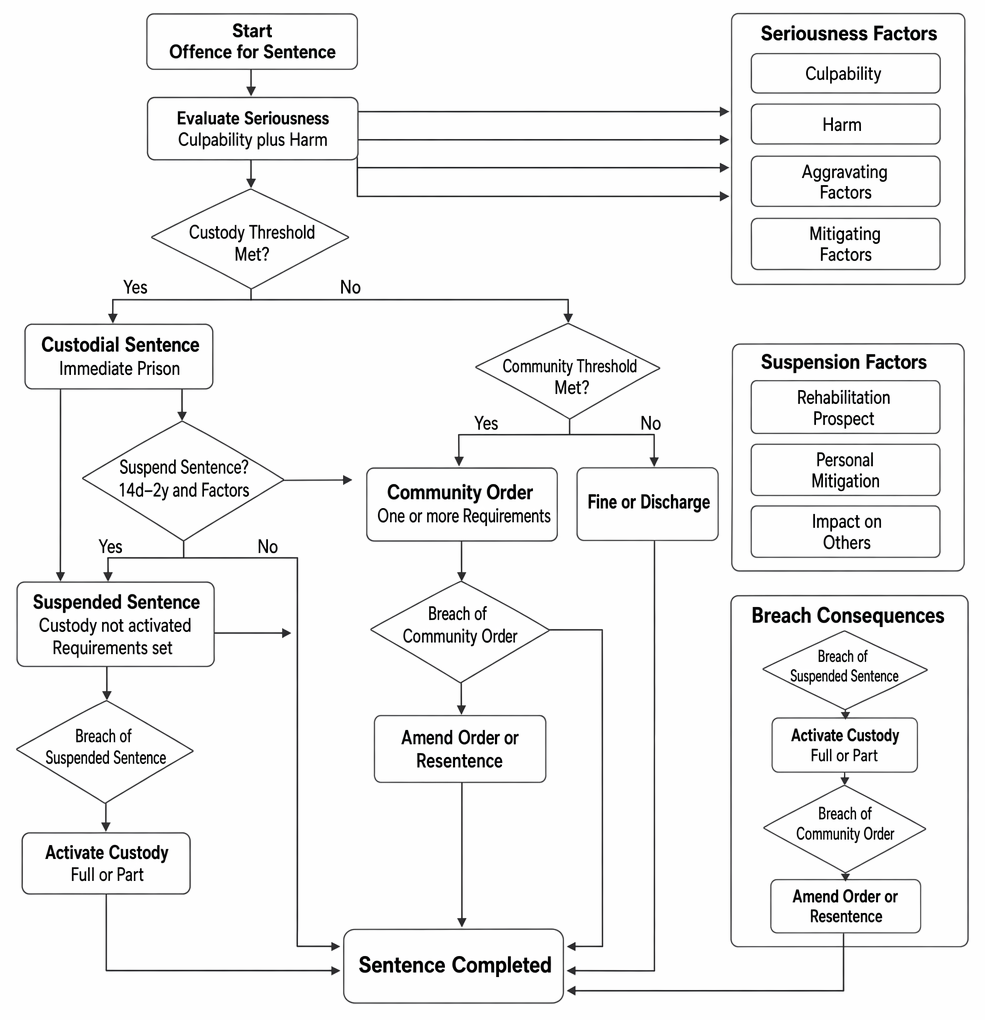
Sentencing pathways from seriousness assessment and custody threshold to immediate custody, suspension, community orders, fines or discharge, and breach outcomes.
Key sentence types are custodial (imprisonment), suspended custodial sentences, and community orders. Understanding when and how each can and should be imposed, as well as the consequences of breach, is fundamental to advising clients, conducting advocacy, and applying for or appealing sentences.
Test Tip: In SQE-style questions on Types of sentences: custodial, suspended, and community orders, identify the legal test, the triggering fact, and the consequence before choosing between similar answer options.
Exam Warning: Do not rely on a familiar phrase from Types of sentences: custodial, suspended, and community orders alone; check whether the facts satisfy every condition, exception, and timing requirement.
Custodial Sentences
A custodial sentence involves the deprivation of liberty by imprisonment, either in a prison or, for some offenders, a young offender institution. It represents the most severe penalty short of life detention and is intended primarily for the most serious criminal offences or where no other disposal can properly reflect the seriousness of the wrongdoing.
Key Term: custodial sentence
A sentence requiring the offender to serve a period of imprisonment, usually in a prison or young offender institution.
The Custody Threshold
Before a custodial sentence can be lawfully imposed, the court must apply the custody threshold: under s 230 of the Sentencing Code 2020, the court must not pass a custodial sentence unless it is satisfied that the offence is so serious that neither a fine alone nor a community sentence can be justified.
Key Term: custody threshold
The legal test requiring that only offences of such seriousness warrant a custodial sentence, as set out in s 230 Sentencing Code 2020.
The court must have due regard to statutory purposes of sentencing (punishment, deterrence, reparation, public protection, and rehabilitation) and is required to follow definitive or applicable Sentencing Council guidelines for the offence unless the interests of justice require a departure.
The threshold test does not mean a custodial sentence is inevitable if crossed. Even if the threshold is met, the court must always ask whether a less severe sentence (including a community order with sufficiently onerous requirements) might still suffice given the purposes of sentencing.
Factors Considered in Applying the Threshold
- The seriousness of the offence, including the harm caused (or intended) and the culpability of the offender.
- The presence and weight of aggravating factors (e.g. previous convictions, offence committed while on bail, use of weapons, targeting a vulnerable victim).
- Any available statutory mitigation or personal circumstances (such as strong evidence of rehabilitation or significant personal hardship to dependants).
- Any statutory minimum sentence requirements in particular cases (e.g. repeat offences of burglary).
The Code requires the court to impose the shortest custodial sentence that is commensurate with the seriousness of the offence and the totality of offending.
Worked Example 1.1
Question: A defendant is convicted of a violent assault. The court finds the offence serious but notes the defendant has no previous convictions and acted under provocation. Should custody be imposed?
Answer:
The court must apply the custody threshold. If the seriousness can be reflected by a community order, custody should not be imposed. The lack of previous convictions and provocation are mitigating factors. Unless the offence is so serious that only custody is justified, a community order should be considered.
Assessing Seriousness
To assess whether the offending justifies custody, the court must have regard to both culpability and harm:
- Culpability: Intention, planning, whether the offender played a leading or minor role, or any aggravating factors such as premeditation.
- Harm: The actual, intended, or foreseeable impact on the victim or others, including physical, emotional, psychological, or financial injury.
- Aggravating Factors: These include previous convictions, commission of the offence on bail, targeting a vulnerable victim, or acting as part of a group.
- Mitigating Factors: Such as age, lack of prior record, genuine remorse, early guilty plea, or evidence of rehabilitation.
Key Term: aggravating factors
Circumstances or characteristics increasing the seriousness of the offence and potentially warranting a more severe sentence. Key Term: mitigating factors
Circumstances or characteristics reducing the seriousness of the offence and potentially justifying a less severe sentence.
Sentence Length
The maximum custodial sentence depends on the offence, the court’s jurisdiction, and any statutory maxima. For example:
- Summary-only offences: The maximum is whatever penalty the statute creating the offence prescribes, typically up to six months’ imprisonment in the magistrates’ court. The twelve-month “general limit” in s 224 Sentencing Act 2020 (as amended from 18 November 2024) does not raise the ceiling for purely summary offences.
- Either-way offences: In the magistrates’ court, the general limit is now twelve months’ imprisonment for a single either-way offence tried summarily (s 224 Sentencing Act 2020), with the same twelve-month ceiling applying in aggregate to consecutive sentences on multiple either-way offences. In the Crown Court, sentences may run to the statutory maximum for the offence.
- Indictable-only offences: Life imprisonment or such lesser maximum as fixed by statute for specific offences.
When determining sentence length, the court must also consider totality, ensuring the sentence for multiple offences is just and not excessive relative to the overall criminality.
Worked Example 1.2
Question: A defendant is convicted of two separate burglaries and a violent assault occurring over several weeks. How does the court determine overall sentence length and structure?
Answer:
The court will first categorise each offence by seriousness using the guidelines. It must then apply the “totality principle” to ensure the combined sentence is proportionate and just, reflecting the overall criminal conduct. For concurrent sentences, the most severe is served; for consecutive, each is served in turn. The court may impose consecutive sentences for unrelated offences or where concurrent sentences would not reflect total offending.
The Totality Principle
Key Term: totality principle
The requirement that the overall sentence for multiple offences is fair and not excessive, considering all offending behaviour together.
This principle ensures sentences for multiple offences reflect the total criminality and that the sentence does not become disproportionate. Courts consider whether to order sentences to be served concurrently (at the same time) or consecutively (one after another), with the rationale based on whether the offences arise from the same incident or are distinct.
Release and Licence Provisions
For most determinate sentences, an offender is released at the halfway point on licence, subject to recall if they breach terms of their release. For sentences of less than twelve months, recall and post-sentence supervision rules also apply. More serious cases, such as “dangerous offenders,” may engage extended sentences or discretionary life sentences.
Life Sentences and Mandatory Minimums
Certain offences, such as murder, attract a mandatory life sentence. In such cases, the judge will set a minimum term to be served before the possibility of release on licence. Statutory minimums also exist for repeat offences under specific statutes. A third conviction for class A drug trafficking carries a minimum of 7 years' imprisonment; where the defendant enters a guilty plea at the first opportunity, the reduction must be such that the final sentence is still at least 80% of the minimum term. A third domestic burglary carries a minimum of 3 years, provided all three offences involved dwellings, with a maximum 20% reduction available for a guilty plea. Certain firearms offences carry a minimum of 5 years' imprisonment. A second offence of possessing a weapon carries a minimum of 6 months, and threatening with a weapon likewise carries a minimum of 6 months.
Credit for Time Served
Any period during which the defendant was remanded in custody before sentence is counted towards the custodial sentence. Where the defendant was subject to electronic monitoring of greater than 9 hours per day while on bail, that time is credited to the sentence on the basis that 1 day on bail with monitoring equals 0.5 days' credit.
Suspended Sentences
A suspended sentence represents a unique approach to custody, allowing an offender to remain in the community while being subject to the threat of immediate imprisonment if conditions are breached. The custodial sentence is imposed but is not activated unless an “activation event” occurs.
Key Term: suspended sentence
A custodial sentence that is not activated immediately but is suspended for a specified period, subject to compliance with requirements.
Statutory Limits and Requirements
Suspended sentences are strictly regulated:
- Only custodial sentences of between 14 days and 2 years (maximum) may be suspended (Sentencing Code 2020, s 189).
- The operational period of suspension can be up to two years.
- The court must first satisfy itself that the custody threshold is met (i.e. the offence is so serious that only custody is appropriate), even though the sentence will be suspended.
- Suspension must be appropriate in the circumstances; it is not a right.
- The custody threshold remains a high bar, but strong personal mitigation or a realistic prospect of rehabilitation may support suspension.
The court is required to attach one or more “requirements” to a suspended sentence unless there are exceptional reasons not to do so. Such requirements are similar to those in community orders (unpaid work, curfew, rehabilitation, etc.).
When Is a Suspended Sentence Suitable?
A court may suspend a custodial sentence if:
- There is a realistic prospect of rehabilitation in the community.
- There is strong personal mitigation, for example, sole responsibility for dependent children, health considerations, or evidence of exceptional hardship.
- Immediate custody would cause significant harmful impact on others.
- Imprisonment is not necessary for the purpose of punishment or public protection.
However, suspended sentences are generally not suitable if there is a significant risk of reoffending, history of poor compliance with court orders, or if deterrence/public protection requires immediate custody.
Worked Example 1.3
Question: A defendant receives a 6-month custodial sentence for theft. The court finds the defendant is the sole carer for a young child and has started rehabilitation. Can the sentence be suspended?
Answer:
Yes, if the custody threshold is met and the sentence is between 14 days and 2 years, the court may suspend the sentence if there is strong mitigation and a realistic prospect of rehabilitation. The court should attach appropriate requirements.
Conditions and Legal Consequences of Breach
Suspended sentences invariably include conditions (requirements). During the “operational period,” the offender must not commit further offences and must comply with all requirements.
If the offender breaches conditions or is convicted of an offence committed during the operational period:
- The court must activate the custodial sentence in whole or in part unless it considers it would be unjust to do so in all the circumstances (s 120 Sentencing Code).
- Practical examples of “unjust” include significant progress on rehabilitation or evidence the breach was minor or technical.
- Where it is unjust to activate, the court may impose more onerous requirements or extend the operational period (up to two years).
- Repeated breaches or further convictions almost invariably result in activation.
Breach proceedings are swift and are intended to give effect to the seriousness with which the court views non-compliance with court orders.
Factors for Suspension and Case Law Guidance
The Sentencing Council places emphasis on a thorough analysis of both the seriousness of the original offence and the practicality of achieving public protection and justice by means other than immediate custody. Factors influencing a decision to suspend include:
- Strong personal mitigation, such as health or family circumstances unconnected to the offence.
- Positive engagement with probation, employment, or voluntary programmes post-offence.
- Demonstrable remorse and voluntary reparation.
- Impact of custody on the dependants of the offender and the community.
Worked Example 1.4
Question: A person with a recent history of breaching previous court orders is convicted of a further offence that crosses the custody threshold. The probation report is negative. Is a suspended sentence appropriate?
Answer:
It is unlikely. A suspended sentence is inappropriate for offenders with a poor history of compliance. In such cases, immediate custody is generally necessary to protect the public interest and uphold the dignity of the court’s orders.
Community Orders
Community orders represent a flexible alternative to custody. They allow courts to tailor specific requirements to address both punishment and rehabilitation in relation to the offence and the offender’s needs.
Key Term: community order
A sentence requiring the offender to comply with one or more requirements in the community, rather than serving a custodial sentence.
Structure and Statutory Requirements
A community order may comprise one or more of the following requirements (Sentencing Code 2020, s 201):
- Unpaid work (community payback) between 40–300 hours.
- Attendance at specified activities or programmes (e.g., to address offending behaviour, substance use, or skills development).
- Rehabilitation activity requirement (support to tackle causes of offending).
- Curfew, monitored by electronic tag (imposed for a specified period, usually between 2 weeks and 12 months).
- Exclusion requirement (bar from specified places).
- Prohibited activity requirement (forbidding specified conduct or association).
- Residence requirement (must live at a specified place).
- Drug or alcohol treatment (with consent), with regular review.
- Mental health treatment requirement (with consent and regular review).
The requirements attached must always be commensurate with the seriousness of the offence and the circumstances of the offender.
The court is required to obtain and consider a pre-sentence report unless it is unnecessary in the circumstances, and must explain in open court why each requirement is imposed.
Key Term: rehabilitation activity requirement
A requirement aimed at addressing the causes of an offender’s criminal behaviour, often incorporating supervision, targeted support, or treatment.
Threshold for Imposing a Community Order
A community order may only be imposed if the offence is “serious enough to warrant” such a sentence (i.e., more than a fine, but less serious than requiring custody). Courts must be satisfied that neither a fine alone nor a discharge reflects the seriousness of the offence.
Worked Example 1.5
Question: A defendant is convicted of a low-level drug offence. The court considers a community order with a drug rehabilitation requirement. What must the court ensure?
Answer:
The court must ensure the offence is serious enough for a community order, the requirement is suitable for the offender, and the offender consents to treatment. The order should be tailored to address the offending behaviour.
Duration and Management of Orders
- The order may be imposed for up to three years, with requirements lasting for specified, commensurate periods.
- The probation service supervises compliance, reports breaches, and assists offenders in meeting the requirements.
- Courts may combine several requirements to fit the individual. Orders must remain proportionate—even where multiple requirements are combined.
Breaches and Non-Compliance
Should the offender breach any requirement of a community order, the court has available a range of sanctions, up to and including the imposition of custody (if the custody threshold was crossed by the original offence):
- Issue a warning following a first breach.
- On a second breach, breach proceedings are initiated, at which point the court may amend the order to make it more onerous by adding requirements or extending duration, impose a fine of up to £2,500, or revoke the order and resentence for the original offence; immediate imprisonment can follow if justified by the original facts and custody threshold.
The court may extend the period of a community order once by up to 6 months beyond the usual three-year limit if necessary. The court must always hold a breach hearing, at which the offender has the right to representation and to present an explanation.
Worked Example 1.6
Question: An offender on a community order with an unpaid work requirement fails to attend required appointments without a good reason. What may occur?
Answer:
The supervising officer will issue a warning. If the breach is repeated or serious, the case will be referred back to court. The court may then add further requirements, impose a more serious penalty, or as a last resort, revoke the order and impose a custodial sentence if the seriousness of the original offence justified custody.
Choice of Requirements
Community orders are inherently flexible and may combine diverse requirements to punish, support rehabilitation, and protect the public. Examples include combining an unpaid work requirement with a curfew to restrict liberty at night or combining treatment for substance misuse with educational activities.
Key Term: exclusion requirement
A condition prohibiting entry to specified premises or places, commonly used to interrupt patterns of offending or protect victims.
Guidance and Judicial Discretion
Although the Sentencing Council’s guidelines are not statutorily binding, courts are obliged to follow them unless justice requires a different approach, and any departure must be clearly set out with reasons. This ensures consistency and fairness in sentencing practice.
The court must also remain alert to the risk of disproportionate hardship—orders should not be so burdensome that they set the offender up to fail or lead to repeated breach.
Sentencing Guidelines and Decision-Making
Sentencing guidelines issued by the Sentencing Council require courts to follow a step-by-step framework:
- Determine the category of the offence based on harm and culpability.
- Identify the starting point and the range available for the offence.
- Adjust the sentence for aggravating and mitigating factors, including previous convictions.
- Apply reductions as appropriate (e.g., for an early guilty plea—usually up to one third if given at the first possible stage).
- Ensure the final sentence is proportionate and reflects the totality of the criminality.
- Where multiple offences are sentenced together, apply the totality principle.
Key Term: purposes of sentencing
The statutory aims of sentencing: punishment, reduction of crime, reform and rehabilitation, protection of the public, and reparation to victims.
Courts are also required to give reasons for, and explain, their sentence in open court, ensuring transparency and accountability, and supporting any possible appeal or review.
Summary
| Sentence Type | Key Features | When Imposed |
|---|---|---|
| Custodial Sentence | Immediate imprisonment; only if custody threshold is met | Offence so serious that no other sentence suffices |
| Suspended Sentence | Custody imposed but not activated; requirements attached | Custody threshold met; strong mitigation/rehabilitation |
| Community Order | Requirements in the community; flexible and tailored | Offence serious enough for more than a fine, but not custody |
Sentencing is a structured process that balances the severity of the offence, the need for deterrence and public protection, and the potential for rehabilitation. Custody is always a last resort, suspended sentences are for exceptional circumstances, and community sentences provide a structured, proportionate, and rehabilitative alternative wherever justified by the offence, the offender, and the purposes of sentencing.
Key Point Checklist
This article has covered the following key knowledge points:
- The custodial threshold requires that custody be a measure of last resort; only the most serious offences justify immediate imprisonment.
- Even if the custody threshold is crossed, the court must consider whether custody is truly unavoidable after weighing alternatives.
- Suspended sentences are available for custodial terms of 14 days to 2 years, but only if both the custody threshold and further discretionary criteria are met.
- Community orders are flexible, combining requirements such as unpaid work, rehabilitation, curfew, and treatment to address both punishment and rehabilitation.
- The consequences for breach of a community order may include more onerous requirements, fines, or, in serious cases where the custody threshold was met, activation of a custodial sentence.
- A breach of a suspended sentence generally leads to activation of the custodial term unless activation would be unjust in all the circumstances.
- Sentencing guidelines and the totality principle ensure sentences are fair, proportionate, and consistent with the purposes of sentencing.
Key Terms and Concepts
- custodial sentence
- custody threshold
- totality principle
- suspended sentence
- community order
- aggravating factors
- mitigating factors
- exclusion requirement
- rehabilitation activity requirement
- purposes of sentencing