Learning Outcomes
This article explores the complex procedures governing how and where a youth (aged 10–17) will be tried when jointly charged with an adult. It thoroughly explains the jurisdiction of the youth court, the circumstances in which a youth must or may be tried alongside an adult in either the magistrates’ or Crown Court, and the legal and practical standards informing that decision. Understanding this topic requires clarity on procedural steps, the legal thresholds for moving cases between courts, and the principles that shape youth justice, such as prioritising the welfare and reformative prospects of young offenders.
Within this framework, specific attention is given to the classification of offences (summary, either-way, indictable-only), the statutory criteria for ‘grave crimes’, applicable sentencing powers in the youth court, and the decisive role of the ‘interests of justice’ test. The article also deals with real-life scenarios in which the adult co-defendant’s chosen venue or plea determines the youth’s procedural path, as well as the critical statutory and guideline safeguards for young people in adult court settings.
SQE1 Syllabus
For SQE1, you are required to understand youth court allocation when youths are jointly charged with adults, with a focus on the following syllabus points:
- The presumption and rationale that youths are tried in the youth court, reflecting the principle of child welfare in criminal proceedings.
- Exceptions to this principle, including trying youths with adults in a magistrates’ or Crown Court, with attention to relevant statutory and case law authority.
- Precise allocation procedure for either-way, indictable-only, and summary-only offences where a youth is jointly charged with an adult.
- The legal definition and implications of 'grave crimes' for youths, including when and how cases are sent to the Crown Court.
- The function and application of the ‘interests of justice’ test, its statutory sources and judicial consideration, particularly in joint trials.
- Application and limitations of the procedural venues for summary, either-way, and indictable-only offences.
- Sentencing powers available to magistrates’ and youth courts when dealing with juveniles, and the impact of grave crime classification.
- Procedural and substantive safeguards for youths in adult courts (such as adaptations, reporting restrictions, and the Sentencing Children and Young People Definitive Guideline).
- Impact of a youth co-defendant turning 18 during proceedings on court allocation and sentencing jurisdiction.
Test Your Knowledge
Attempt these questions before reading this article. If you find some difficult or cannot remember the answers, look more closely at that area during your revision.
-
Where does a case involving a youth jointly charged with an adult usually commence?
- a) Youth Court
- b) Crown Court
- c) Magistrates' Court (adult court)
- d) High Court
-
True or False: A youth jointly charged with an adult for an indictable-only offence must always be sent directly to the Crown Court alongside the adult.
-
What is the primary consideration for the court when deciding whether to try a youth jointly with an adult in the Crown Court?
- a) The age of the youth
- b) The preference of the youth's parents
- c) The seriousness of the offence
- d) The interests of justice
Introduction
When a person under 18 (a youth) is accused of a criminal offence, the established rule is that their case should be heard in the youth court, a specialist jurisdiction designed for young defendants. This structure emphasises rehabilitation over punishment and accords with the statutory imperative found in s.44 of the Children and Young Persons Act 1933, which compels the court to have regard to the welfare of the child or young person at every stage. Still, when a youth is jointly charged with an adult, the process is complicated by the necessity to coordinate the defendants’ court paths, often resulting in the youth's case being initiated and possibly tried outside the youth court.
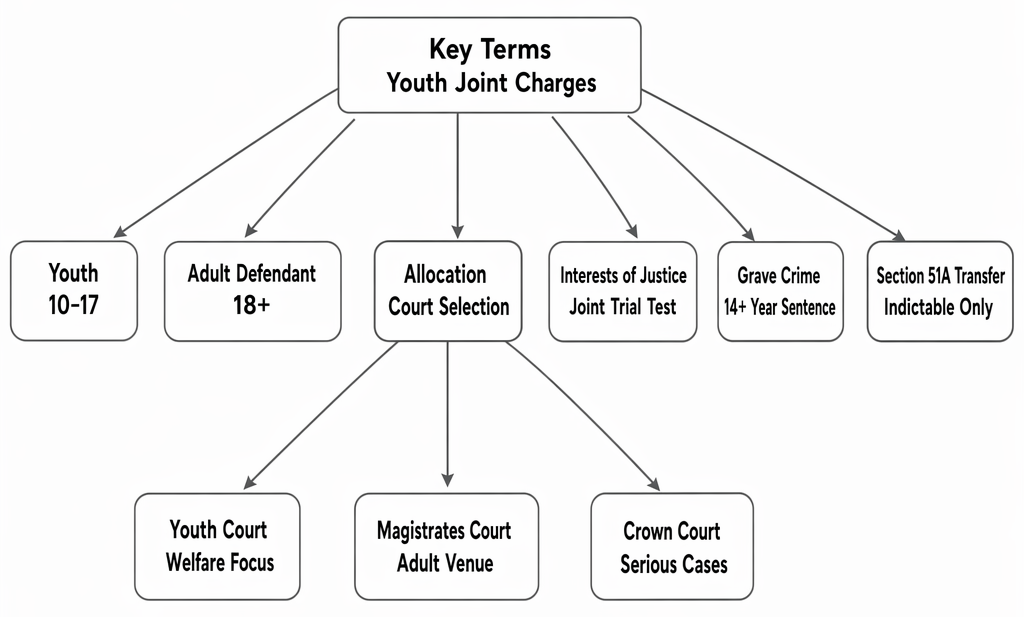
Allocation of youths charged with adults spans youth court, magistrates’ court and Crown Court, with interests of justice and grave crime.
Key Term: Youth
In criminal proceedings, a youth is someone who was aged 10 or over but under 18 at the time the offence was allegedly committed. Key Term: Allocation
Allocation is the procedural mechanism for determining where (i.e. in what court) a case will be tried, taking account of the classification of the offence, the defendant’s age, and the jurisdictional rules applicable to the defendant or any co-defendants.Test Tip: In SQE-style questions on Allocation procedures for youths jointly charged with adults, identify the legal test, the triggering fact, and the consequence before choosing between similar answer options.
Exam Warning: Do not rely on a familiar phrase from Allocation procedures for youths jointly charged with adults alone; check whether the facts satisfy every condition, exception, and timing requirement.
General Principles of Youth Court Jurisdiction
The foundational rule is that all youths (aged 10–17) charged with criminal offences are to be tried summarily in the youth court, irrespective of the seriousness or classification of the alleged offence. This stems from the overriding aim of the youth justice system—to prevent offending by children and young persons and to prioritise their rehabilitation and welfare over punitive ends.
However, this jurisdictional default is displaced in defined scenarios:
- Homicide Offences: All homicides, including murder, manslaughter, and attempts, must be tried in the Crown Court, regardless of the defendant’s age. The youth court is not legally permitted to try such offences, nor can it accept a plea.
- Grave Crimes: Certain serious either-way offences, where the maximum possible adult sentence is 14 years or more, may be sent to the Crown Court if the youth court considers its own sentencing powers insufficient; this includes offences such as robbery and s.18 GBH.
- Joint Charges with Adults: Specific rules govern the allocation of cases involving youths charged together with adults. Trial and consistency in verdicts are sometimes necessary.
- Turning 18 During Proceedings: Where a youth turns 18 before or during proceedings, the court will determine allocation and sentencing jurisdiction having regard to fairness and practicality, ensuring the best interests of justice are preserved.
Allocation When Jointly Charged with an Adult
When a youth is jointly charged with an adult for the same offence or for offences arising from the same or connected facts, both defendants make their first appearance together in an adult magistrates’ court. The court’s decisions at this critical point are dictated by the classification of the offence, as well as the plea and procedural choices made by the adult co-defendant.
The allocation process is expressly governed by statute (primarily the Magistrates’ Courts Act 1980, the Crime and Disorder Act 1998, and the Criminal Procedure Rules 2020) and is informed by Sentencing Council and judicial guidance, especially the Sentencing Children and Young People Guideline (2017).
The default route is as follows:
- The adult’s case is dealt with first, with the court determining allocation and, for either-way offences, inviting a plea from the adult defendant.
- The allocation and procedural path for the youth is contingent on what happens with the adult’s case at this first hearing.
Procedure for Either-Way Offences
If the jointly charged offence is triable either way (such as theft or ABH), the following procedure applies in the adult magistrates’ court:
- The magistrates first determine the trial venue for the adult defendant. This involves considering the seriousness of the offence, the sentencing powers available, the adult’s plea, and any representations as to court suitability made by prosecution or defence.
- If the adult defendant pleads not guilty, or does not indicate a plea, the magistrates proceed to an allocation (mode of trial) hearing for the adult, considering the factors in s.19 MCA 1980 and following the Allocation Guideline issued by the Sentencing Council.
- If the magistrates decide the offence is so serious as to merit Crown Court trial, or the adult elects trial by jury even though the magistrates would have accepted jurisdiction, the adult is sent to the Crown Court for trial. The youth's case is then considered.
For the youth, the magistrates court will:
- After the adult's allocation, ask the youth to indicate plea.
- If the youth pleads guilty, the usual route is to remit the case to the youth court for sentence, though exceptional circumstances may warrant sentencing in the magistrates’ court or, for a grave crime, committal to the Crown Court for sentence.
- If the youth pleads not guilty or declines to indicate a plea, the court must apply the ‘interests of justice’ test to decide whether it is appropriate to send the youth to the Crown Court to be tried with the adult, or whether to remit the youth’s case to the youth court for separate trial.
Key Term: Interests of Justice
The interests of justice test is a balancing exercise where the magistrates consider whether it is fair and efficient for the youth and adult to be tried together, or whether the youth’s welfare and rehabilitation would be better served by a separate trial in the youth court. Relevant factors include:
- The age, maturity, and vulnerability of the youth.
- The seriousness and complexity of the case.
- The likelihood of inconsistent verdicts or duplicative proceedings if cases are severed.
- The extent to which the youth’s culpability and circumstances differ from the adult’s.
- Any risks of unfair prejudice to the youth if tried in a more formal adult court environment.
- The desirability of efficient case management and economy of judicial time.
If, on this assessment, the court considers it is in the interests of justice for a joint trial, the youth is sent to the Crown Court for trial with the adult. If not, the youth's case is remitted to the youth court for trial.
If the adult is to be tried summarily in the magistrates' court, a youth who pleads not guilty will generally be tried alongside the adult in the adult magistrates’ court, unless the court exercises its discretion to remit the case back to the youth court (for example, if special circumstances of prejudice arise).
Where both are to be tried together in the adult magistrates’ court, careful consideration is expected of the court to ensure the youth’s vulnerabilities are accommodated and adequate support is provided during proceedings.
Sentencing Following Summary Conviction
If convicted in the adult magistrates’ court, the youth is usually remitted to the youth court for sentencing, unless the court considers it expedient or just to dispose of the sentence itself, taking account of the youth’s circumstances and the joint nature of the conviction. Where the offence is a grave crime, the magistrates may commit the youth to the Crown Court for sentence if they consider their powers insufficient.
Procedure for Indictable-Only Offences
Where the offence is indictable-only (such as murder, manslaughter, or s.18 GBH), the adult must be sent directly to the Crown Court for trial pursuant to s.51A Crime and Disorder Act 1998. If a youth is jointly charged with an adult for an indictable-only offence, the youth must also be sent forthwith to the Crown Court for trial with the adult—regardless of the youth’s plea or the various interests of justice factors. The youth court’s summary jurisdiction does not apply for indictable-only offences, reflecting the seriousness and complexity of these cases and the need for consistency in outcome.
In such cases, there is no allocation or mode of trial hearing for the youth; both defendants are treated identically as to allocation and are sent to the Crown Court for trial.
Procedure for Summary-Only Offences
If both youth and adult are charged with a summary-only offence (including the specific summary-only jurisdiction for certain low-value shoplifting and criminal damage), their case will be heard in the magistrates’ court. The youth may be tried alongside the adult unless the court deems there is a compelling reason (such as undue prejudice or a need to safeguard the youth’s welfare) to remit the case to the youth court. However, if an adult defendant pleads guilty or their case is withdrawn or dismissed, the youth is normally remitted to the youth court for trial or sentencing.
Grave Crimes Exception
Certain either-way offences, referred to as grave crimes, may permit or require the youth’s case to be tried in the Crown Court even if the adult co-defendant is not tried in the Crown Court, or even if the interests of justice test would otherwise favour trial in the youth court.
Key Term: Grave Crime
Grave crimes are those either-way offences for which an adult aged 21 or over could be sentenced to imprisonment for 14 years or more (e.g., robbery, s.18 GBH, and aggravated arson). Where a youth is charged with such a crime, the court must assess whether, based on the facts and the youth’s circumstances, there is a real prospect (not a theoretical possibility) that a sentence in excess of the youth court’s maximum (currently 24 months’ Detention and Training Order) will be required upon conviction.
If the magistrates consider their sentencing powers inadequate—meaning a significantly longer custodial period would be appropriate—the youth can be sent to the Crown Court for trial (if not co-joined with an adult already going there) or for sentence (following conviction in the youth or magistrates' court).
In cases involving grave crimes, the court must first take the youth’s plea. If not guilty, the youth is subject to allocation as above; if the criteria for grave crime are met, the case may be sent to the Crown Court regardless of the adult’s procedural outcome.
Intersection with Other Youth Justice Principles
It is essential to acknowledge that these allocation decisions are shaped by broader youth justice objectives and statutory protections:
- The welfare and best interests of the youth are always the foremost consideration and are mandated as the court’s first consideration.
- The court must explain proceedings clearly in age-appropriate language and safeguard the youth’s rights, particularly if any decision is made to try the youth in an adult court.
- Where possible, the proceedings must be managed to avoid unnecessary delay and multiple court appearances.
Worked Example 1.1
Chloe (16) and David (19) are jointly charged with theft (an either-way offence) from a shop. Both appear at the adult magistrates' court. David indicates a not guilty plea. The magistrates accept jurisdiction for David's case, but David elects trial in the Crown Court. Chloe indicates a not guilty plea.
Answer:
The magistrates must now determine whether it is in the interests of justice for Chloe to be sent to the Crown Court to be tried alongside David. They must weigh Chloe's age, potential for prejudice (including her greater vulnerability in the Crown Court environment), the facts and complexity of the case (often straightforward for theft), the advantages of joint trial (chiefly efficiency and avoidance of inconsistent verdicts), and any distinctive factors in Chloe's situation. Unless there are particular factors suggesting the necessity of a joint trial, best practice—in keeping with Youth Court Bench Book and Sentencing Council guidance—favours remitting Chloe’s case to the youth court.
Worked Example 1.2
Ahmed (15) and Bilal (20) are jointly charged with robbery (an indictable-only offence). They appear at the adult magistrates' court.
Answer:
Robbery is an indictable-only offence. The Crime and Disorder Act 1998, s.51A, mandates that Bilal must be sent to the Crown Court for trial. Ahmed, as a youth jointly charged, must also be sent directly to the Crown Court to be tried with Bilal. There is no allocation or mode of trial hearing for Ahmed; the seriousness of the charge and statutory requirements govern allocation.
Worked Example 1.3
Roma (17) and Sam (23) are jointly charged with aggravated arson—an either-way offence and a grave crime. The magistrates accept jurisdiction for Sam, who elects summary trial and pleads not guilty. Roma pleads not guilty.
Answer:
Aggravated arson is a grave crime for which, if convicted, an adult could receive a sentence of 14 years or more. Given Roma’s plea, the youth court must consider whether there is a real prospect that a sentence exceeding its 24-month Detention and Training Order powers would be appropriate for Roma. If so, Roma's case can be sent to the Crown Court for trial, even though Sam's case remains in the magistrates' court. If not, Roma should be tried in the youth court, and if convicted, the youth court can still commit Roma to Crown Court for sentencing if at that stage it appears necessary.
Safeguards for Youths in Adult Courts
Whenever a youth is tried in an adult court (either magistrates’ or Crown Court), safeguarding their welfare becomes even more important. Specific measures and legal guarantees must be implemented to reduce harm and ensure a fair trial:
- Courtroom Modifications: The environment should, as far as feasible, be made less formal—for example, allowing the youth to be seated instead of standing, adapting the proceedings to the youth’s level of understanding, and limiting the use of intimidating or unnecessarily legalistic language.
- Reporting Restrictions: Statutory reporting restrictions generally prohibit identifying details of youth defendants in all courts to minimise stigma and facilitate rehabilitation, unless overridden by a specific court order in the interests of justice.
- Support Persons: Youths should, where possible, be accompanied by parents, guardians, or appropriate adults who may assist in understanding and participating in the proceedings. If appropriate adults or family members are unavailable, the court may involve a social worker or other responsible adult.
- Application of Youth Sentencing Guidelines: When sentencing a youth in any court, the judge or magistrate must apply the Sentencing Children and Young People Definitive Guideline, ensuring sentences remain proportionate to a youth’s developmental, emotional and welfare profile and are designed to encourage reintegration, not simply punishment.
- Procedural Fairness: The youth court’s informality and supportive ethos should be, to the extent possible, replicated in adult court trials and sentencing for youths. The legal representative is responsible for drawing the court’s attention to relevant vulnerabilities and advocating for appropriate adjustments.
For grave crimes, where a youth is convicted in the Crown Court, the judge may impose a longer period of detention under the Sentencing Code’s powers relating to grave crimes and dangerous offenders. However, the principles of welfare and the necessity of custody as a last resort still apply.
Intersection with Professional Conduct
Defence solicitors facing these scenarios must act in the child’s best interests, ensuring that the youth’s welfare, procedural fairness, and long-term prospects are robustly safeguarded. Solicitors must provide clear, age-appropriate explanation of procedural options, ensure the youth’s right to silence and legal representation are respected, and be vigilant to possible conflicts of interest or situations where the youth may be adversely affected by the presence or conduct of adult co-defendants. If the youth admits guilt privately but intends to plead not guilty, the solicitor's duty to the court prevails over client instructions in public, consistent with the SRA Code of Conduct.
Further, solicitors must ensure any vulnerability or special educational need is flagged and that support (such as intermediaries or special measures) is available where appropriate, both at the stage of taking instructions and at all hearings.
Key Point Checklist
This article has covered the following key knowledge points:
- Youths are ordinarily tried in the youth court to uphold their welfare, using the least formal and most rehabilitative forum.
- When a youth is jointly charged with an adult, both appear in the adult magistrates' court for their initial hearing and allocation.
- For indictable-only offences, both adult and youth are sent directly to the Crown Court under statutory mandate.
- For either-way offences, where the adult is sent to the Crown Court, the youth's allocation is determined by the application of the ‘interests of justice’ test, taking into account specific welfare and procedural considerations.
- Where the adult is to be tried summarily, the youth will usually be tried alongside in the magistrates’ court, with the option to revert to youth court in special cases.
- Grave crime provisions may result in a youth being tried or sentenced in the Crown Court if the likely penalty exceeds the youth court’s maximum powers, regardless of the adult co-defendant’s outcome.
- Detailed safeguards exist to protect youths in adult court settings, including adjusted procedure, automatic reporting restrictions, access to appropriate adults, and the requirement to apply the Sentencing Children and Young People Definitive Guideline.
- The defence solicitor’s professional obligations demand careful balancing of loyalty to the youth client with overriding duties to the court, and the proactive securing of all appropriate procedural and welfare protections.
Key Terms and Concepts
- Youth
- Allocation
- Interests of Justice
- Grave Crime