Learning Outcomes
This article explains Youth Court referral orders as a core sentencing disposal, including:
- the statutory criteria determining when a referral order is mandatory, discretionary, or unavailable, and how these interact with guilty pleas and previous convictions
- the court’s powers in fixing the duration of a referral order and distinguishing it from Youth Rehabilitation Orders and Detention and Training Orders
- the composition, role, and decision‑making responsibilities of the Youth Offender Panel in engaging the young person and their family
- the structure, negotiation, and enforceability of Youth Offender Contracts, including typical reparative, rehabilitative, and restrictive requirements
- the legal framework and practical steps for dealing with non‑compliance and breach, and the Youth Court’s options on continuation, amendment, or revocation and resentencing
- the restorative justice principles underpinning referral orders and their place within the broader youth sentencing framework and Scaled Approach
- the application of the Sentencing Children and Young People Definitive Guideline to referral orders, focusing on welfare, proportionality, and prevention of reoffending
- the ability to analyse problem questions involving first‑time and repeat youth offenders, identify when a referral order is appropriate, and predict likely court responses to breach
SQE1 Syllabus
For SQE1, you are required to understand Youth Court referral orders as a core youth sentencing disposal, including eligibility, imposition, operational mechanics, Youth Offender Panels and Youth Offender Contracts, duration, breach procedures, and their relationship to other youth sentences, with a focus on the following syllabus points:
- The mandatory and discretionary circumstances for imposing a referral order: statutory provisions, eligibility criteria, and exceptions.
- The operational mechanics of referral orders: procedure, duration, requirements, and distinctiveness from other community sentences.
- The composition and decision-making responsibilities of the Youth Offender Panel under a referral order.
- The structure and enforceability of Youth Offender Contracts, including potential requirements and the principle of tailored intervention.
- The Youth Court’s procedural and sentencing options in the event of breach of a referral order or contract, including possible amendment, continuation, or resentencing.
- The restorative justice principles embodied in referral orders and their role within the spectrum of youth sentencing as set out by the Sentencing Children and Young People Definitive Guideline.
- Relevant statutory sources, including the Sentencing Act 2020 (SA 2020), Powers of Criminal Courts (Sentencing) Act 2000, and guidance from the Youth Justice Board.
- The contrast with and relationship to other sentences available to youth offenders such as Youth Rehabilitation Orders and Detention and Training Orders.
Test Your Knowledge
Attempt these questions before reading this article. If you find some difficult or cannot remember the answers, look more closely at that area during your revision.
-
Under what primary condition MUST a court impose a referral order on a young offender?
- a) The offence committed is imprisonable.
- b) The offender pleads guilty to an imprisonable offence and has no previous convictions.
- c) The offender is under 16 years old.
- d) The victim requests a restorative justice approach.
-
Which body is responsible for meeting with the young offender and agreeing the terms of the Youth Offender Contract?
- a) The Magistrates' Court
- b) The Youth Offending Team
- c) The Youth Offender Panel
- d) The Probation Service
-
True or false? A referral order can last for a maximum period of 24 months.
Introduction
When sentencing young offenders aged 10–17, the Youth Court must determine not only the appropriate level of punishment for the offence but also how best to support the child or young person in addressing and reducing offending behaviour. Referral orders were introduced as a bespoke community-based response for first-time youth offenders who plead guilty, reflecting the principle that effective intervention and accountability can be more productive than a strictly punitive approach. Their restorative justice orientation is designed to involve victims, families, and the community, and to encourage a sense of responsibility and reparation.
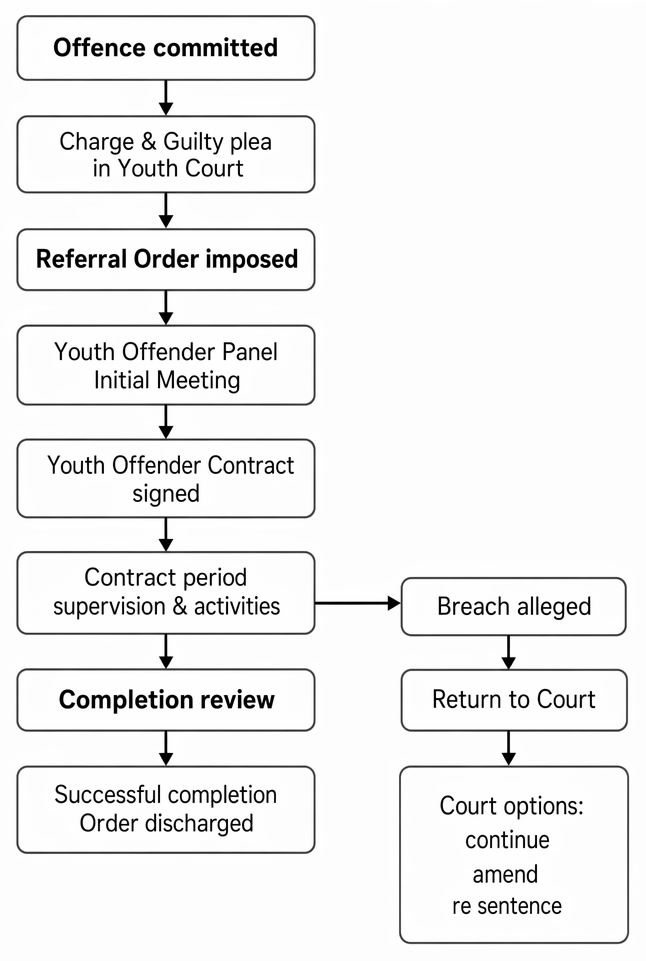
Youth Court referral order procedure from guilty plea to completion, including panel meeting, contract supervision, and court response to breach.
Referral orders are currently governed by the Sentencing Act 2020 (notably ss.239–248), replacing earlier provisions in the Powers of Criminal Courts (Sentencing) Act 2000. They represent a sentence intended to address the main causes of criminal behaviour among youths while incorporating reparative elements and supporting the reintegration of the young person into society.
Key Term: Referral Order
A community-based sentence imposed on a young offender requiring them to attend meetings with a Youth Offender Panel and participate in a contract designed to prevent further offending and make reparation to victims or the community.
Compared to adult sentences, referral orders are distinct in their focus on collaborative engagement between the offender, the victim, and the community, and their flexibility in tailoring requirements to the individual’s circumstances.
Test Tip: In SQE-style questions on Referral orders, identify the legal test, the triggering fact, and the consequence before choosing between similar answer options.
Eligibility and Imposition of Referral Orders
Referral orders form a central sentencing mechanism within the Youth Court for young offenders who have pleaded guilty. Their imposition is closely regulated by statute and is guided by principles contained in the Sentencing Children and Young People Definitive Guideline. Understanding the strict statutory criteria, the operation of judicial discretion, and the relevant exceptions is essential.
Mandatory Referral Orders
A Youth Court must impose a referral order in the following circumstances (SA 2020, s.239):
- The offender is aged under 18 at the date of conviction.
- The offence is imprisonable for an adult (i.e. carrying potential for a custodial sentence).
- The offender has pleaded guilty to the offence, and, if sentenced for more than one offence, has pleaded guilty to all offences being dealt with together.
- The court is not proposing to impose a custodial sentence (such as a Detention and Training Order) or to grant an absolute discharge.
- The offender has no previous convictions or relevant bound-over orders (in any court).
Where all of these conditions are satisfied, the Youth Court must impose a referral order irrespective of other considerations, unless the case falls within tightly drawn exceptions.
The rationale for this strict requirement is to divert first-time youth offenders from the stigma of more punitive sentences, offer a structured opportunity for rehabilitation, and harness the potential for positive behavioural change through restorative practices. Referral orders cannot be imposed if the child pleads not guilty and is convicted after trial; a guilty plea is an explicit precondition.
Key Term: Imprisonable Offence
An offence for which the court has power to impose a custodial sentence on conviction (regardless of whether custody is imposed in the particular case).
This approach reflects the principle that sentencing should primarily focus on preventing reoffending and supporting the welfare and rehabilitation of the child or young person (Sentencing Children and Young People Guideline).
Discretionary Referral Orders
While the referral order is mandatory in certain strictly defined cases, the court retains discretion to impose such an order in a broader range of circumstances:
- The offender pleads guilty to some, but not all, of the offences before the court. Where a guilty plea is entered to some offences, and the court finds guilt on others, the referral order may be available but is not required; the court must consider all relevant factors to decide if it is appropriate.
- The offender has prior convictions but has never before been subject to a referral order. The Sentencing Act 2020 allows a discretionary referral order if the offender, despite previous convictions, has not previously received this sentence.
- In exceptional cases, the court may make a further referral order even if the young person has previously been the subject of such an order, but only where exceptional circumstances exist to justify it. The Youth Offending Team (YOT) may recommend a further referral order, for example, if the previous order was breached for reasons beyond the offender's control or if there are compelling welfare considerations.
However, a referral order cannot be made if the child has pleaded not guilty to all offences and is convicted after full trial.
Key Term: Youth Offending Team (YOT)
A statutory multi-agency team that works with young people in the criminal justice system, including supporting Youth Offender Panels in the delivery and oversight of referral orders.
Duration of a Referral Order
The duration of a referral order must be set by the court at between three and twelve months (SA 2020, s.241). The length should be proportionate to the seriousness of the offence(s), any aggravating or mitigating circumstances, and the young person’s needs and assessed risk level. Guidance suggests three to five months for less serious offending, and up to ten to twelve months for the most serious offences within the referral order regime.
It is not possible for the court to specify a period longer than twelve months for a referral order. (Note: A referral order is distinct from Youth Rehabilitation Orders, which may last up to three years, and Detention and Training Orders, which may include custodial elements.)
The referral order takes effect from the date it is imposed, but the requirement to attend the Youth Offender Panel begins when the referral panel is first convened—usually within 20 days of sentence. The order remains active throughout the agreed period, subject to compliance with the Youth Offender Contract.
Worked Example 1.1
Chloe, aged 15, pleads guilty to her first offence, theft from a shop (an imprisonable offence). The Youth Court decides against custody or an absolute discharge. What sentence must the court impose?
Answer:
The court must impose a Referral Order. All mandatory conditions under SA 2020, s.239 are met: Chloe is under 18, the offence is imprisonable, she pleaded guilty, she has no previous convictions, and neither custody nor absolute discharge is considered appropriate.
Worked Example 1.2
Sam, aged 16, pleads guilty to a public order offence and has received a previous conviction for criminal damage (for which no referral order was made). Is a referral order available as a sentence?
Answer:
The court may impose a referral order. Although Sam is not a first-time offender, he has not previously received a referral order. The court retains discretion to impose one if it considers it appropriate in the circumstances.
The Youth Offender Panel and Contract
Once a referral order has been imposed, the matter is referred to a Youth Offender Panel (YOP), which forms the core mechanism for delivering the aims of the sentence.
Key Term: Youth Offender Panel (YOP)
A statutory panel comprising at least one member of the Youth Offending Team and two trained community volunteers. The panel meets with the young offender and their family to agree a contract focused on preventing reoffending and making reparation.
The Youth Offender Panel is established by the relevant YOT and takes responsibility for the structured engagement with the young person and their parent(s) or carer(s). Initial meetings with the panel must occur within three weeks of the referral order being made.
The family’s participation is not optional—parents or guardians may be compelled by the court to attend panel meetings if it is considered to support the aims of the intervention.
The function of the Youth Offender Panel is threefold:
- To discuss the circumstances of the offence in depth with the young person, building awareness and personal accountability.
- To agree a Youth Offender Contract containing individualised requirements aimed at prevention, restoration, and rehabilitation.
- To offer practical support or guidance to help the young person address difficulties contributing to their offending (e.g., education, family relationships, substance misuse).
Where appropriate, the victim or their representative may also be invited to attend panel meetings, supporting restorative justice and direct reparation.
The Youth Offender Contract
The Youth Offender Contract is central to the operation of a referral order. It is a tailored, written agreement between the panel and the young offender (and their family) that sets out the specific actions, interventions, and prohibitions that the youth must comply with during the period of the order. The contract is agreed by negotiation but must be signed by the young person to be valid.
Aims and Requirements of the Contract
The requirements included in the contract are designed to achieve one or more of the following objectives as guided by statute (SA 2020, s.242) and the Sentencing Children and Young People Guideline:
- Reparation: The young person may be required to make amends to the victim or the local community. Examples include writing a letter of apology, carrying out unpaid work to benefit the victim or community, or participating in restorative meetings.
- Restorative Justice: Whenever possible, the views and needs of victims are taken into account. Victim participation is voluntary, but the process is designed to encourage understanding and direct reparation.
- Preventing Reoffending/Intervention: The contract often requires engagement with interventions aimed at the causes of offending, such as attending substance misuse treatment, participating in educational or training programmes, or engaging with anger management or cognitive skills courses.
- Prohibitions and Restrictions: These may include staying away from certain locations or associates, compliance with a curfew, or restrictions on movement at specified times to reduce the risk of reoffending.
- Positive Activities: The young person may be directed to participate in constructive activities (e.g., sports, volunteering, or community projects) that are designed to build self-esteem, skills, or social responsibility.
The contract is bespoke, reflecting the young person’s offending, risk profile, welfare needs, and the harm caused. The youth must normally attend regular meetings or sessions to monitor and review progress and compliance.
The contract may also include support for family members or carers and referral to outside agencies (such as social services, mental health professionals, or educational support). The involvement of the parent(s)/guardian(s) encourages a supportive environment for the young person’s rehabilitation.
A Youth Offender Panel cannot impose custodial-style requirements; it operates within the bounds of community-based intervention, always prioritising welfare and proportionality.
Process if No Agreement is Reached
If the young person refuses to agree to the contract or persistently fails to cooperate with the panel at the outset, the case is referred back to the Youth Court. The failure to engage may lead the court to revoke the referral order and impose an alternative sentence, which may be more severe.
Worked Example 1.3
Jamal, 14, is made subject to a 6-month referral order for his first offence. At the panel meeting, he and his family agree a contract that requires attending weekly mentoring sessions, apologising to the victim, and observing a curfew at weekends. The victim joins one of the meetings and expresses how the offence affected them.
Answer:
This is a typical example of a Youth Offender Panel process and contract. The structured mix of reparation, intervention, and restrictions reflects the rehabilitative and restorative rationale, with victim involvement enhancing the restorative impact.
Breach of a Referral Order
A key feature of referral orders is the enforceability of the Youth Offender Contract. Compliance underpins the entire sentence; persistent or significant non-compliance undermines rehabilitative aims and triggers statutory breach procedures.
Nature of Breach
Breach arises where the young person, without reasonable excuse, fails to comply with the requirements of the Youth Offender Contract. Breaches may include repeatedly missing required sessions, failing to undertake agreed reparation, or acting in direct contravention of set restrictions.
Minor, technical breaches may be addressed with warnings and support, but sustained or wilful non-compliance must be escalated.
Procedure on Breach
If it becomes apparent that the young person has breached the contract, the Youth Offender Panel must refer the matter back to the Youth Court (SA 2020, s.248). The Youth Court will then hold a breach hearing.
At the hearing, the court must determine whether, on the balance of probabilities, the offender breached the contract without reasonable excuse. The offender has an opportunity to provide an explanation or mitigating circumstances.
If a breach is found, the court has several statutory options:
- Allow the referral order to continue with the existing contract terms (usually reserved for minor or first breaches).
- Amend the contract, which may involve adding more onerous or specific requirements to address the breach.
- Revoke the referral order and re-sentence the young person for the original offence, using any sentencing option that would have been available at the point of the original sentence (including a Youth Rehabilitation Order, or, where the offence justified, a Detention and Training Order).
The possibility of re-sentencing acts as an incentive for compliance, as non-compliance could result in a more significant and restrictive penalty.
The court will only opt for the most severe response—revocation and re-sentencing—where lesser responses have failed or are clearly inadequate given the circumstances of the non-compliance.
Worked Example 1.4
David, aged 16, received a 9-month referral order for assault occasioning actual bodily harm after pleading guilty. His Youth Offender Contract required him to attend weekly anger management sessions. He missed three consecutive sessions without providing a reason. The YOP referred the breach back to the Youth Court. David admits the breach but claims he forgot the appointment times.
Answer:
The court must first decide if David had a 'reasonable excuse'. Forgetting appointments is unlikely to be deemed reasonable. If satisfied beyond reasonable doubt that there was no reasonable excuse, the court can: (a) let the order continue unchanged (unlikely given repeated breaches); (b) amend the contract (for example, add further requirements or support); or (c) revoke the order and re-sentence David for the original ABH offence, with sentencing options including a YRO or DTO if warranted by the seriousness of the case.
Further Considerations on Breach
If the breach stems from the young person’s main vulnerabilities (such as mental health issues or learning disabilities), the court is required to carefully consider these in determining an appropriate response—reflecting the welfare principle fundamental to youth sentencing. Persistent or repeated failures, particularly where the YOT or YOP have provided support and warnings, make revocation and re-sentencing much more likely.
If a referral order is revoked, the Youth Court is empowered to impose any sentence that was available when the original referral order was made. This may, in serious cases, lead to the imposition of more restrictive sentences such as a Youth Rehabilitation Order with more intensive requirements, or, for more serious offences, a Detention and Training Order (subject to the statutory age limits and criteria).
There is no prescribed restriction on the number of breach hearings that can take place; however, repeated failures can rapidly reduce the court’s willingness to allow the referral order to continue.
Worked Example 1.5
Emma, 13, received a 5-month referral order for criminal damage after pleading guilty. Her contract required attending a weekly art class to encourage engagement with school and carrying out 10 hours of community reparation. Emma completed the reparation but repeatedly missed the art classes, citing anxiety about attending new activities. What factors should the Youth Court consider at her breach hearing?
Answer:
The court must consider whether Emma had a reasonable excuse, such as documented and significant anxiety. If this is established, the breach may not be proved and the order may continue unchanged or be amended with more appropriate support. If no reasonable excuse, the court can amend the contract or, in more serious or persistent cases, revoke the order and impose an alternative sentence. Welfare and proportionality must inform the response.Revision Tip: Remember that a breach relates specifically to the requirements of the Youth Offender Contract, not to further criminal offending (although new offending may lead to a breach referral and separate proceedings). A new offence committed during a referral order does not automatically mean breach of the order, but it will be considered when reviewing compliance and suitability for continuation.
Wider Context: Referral Orders in the Youth Sentencing Framework
Referral orders sit alongside Youth Rehabilitation Orders (YROs) and Detention and Training Orders (DTOs) as core disposals available to youth courts.
- Youth Rehabilitation Orders (YROs): These are more flexible, can include a wide range of requirements, and can last up to three years. YROs are typically reserved for more serious or repeat offenders, or where a referral order is unavailable or has failed.
- Detention and Training Orders (DTOs): DTOs are the primary custodial sentence available to the Youth Court and should only be imposed where the offence is so serious that neither a referral order nor a YRO (even with intensive supervision) is justified. The age of the offender at the time of sentence (and, in rare cases, at the commission of the offence) affects the availability of a DTO.
Referral orders function as a point of early, meaningful intervention, and their emphasis on collaboration and reparative justice reflects their place at the less punitive end of the sentencing spectrum. They can only be imposed by the Youth Court or an adult magistrates' court sitting in its youth jurisdiction; the Crown Court cannot make a referral order. Only where a referral order is unavailable, has already been imposed (save for exceptional cases), or has failed, will other, more severe sentences be considered.
Key Term: Scaled Approach
A framework used by the Youth Offending Team to tailor intervention levels to individual risk and need, ensuring that the intensity and duration of the referral order and its requirements are proportionate and effective in reducing reoffending.
The Sentencing Children and Young People Definitive Guideline requires that sentences for youths should be individualised, with primary regard given to preventing offending and ensuring the welfare and reintegration of the young person, rather than punishment alone.
Key Point Checklist
This article has covered the following key knowledge points:
- Referral orders are a central, community-based sentencing option designed for offenders under 18 who plead guilty to an imprisonable offence and have no previous convictions.
- A referral order must be imposed where statutory conditions are satisfied: the offender pleads guilty, is under 18, has no previous convictions or bindings over, and imprisonment or absolute discharge is not being considered.
- The Youth Court retains a discretion to impose referral orders in other circumstances, primarily for those who have not previously been given such an order and in exceptional cases where further referral orders are justified.
- Referral orders are not available where the offender has pleaded not guilty to all charges and is convicted after trial; a guilty plea is required.
- The referral order requires engagement with a Youth Offender Panel, a multi-agency, community-based group tasked with agreeing a tailored Youth Offender Contract.
- The Youth Offender Contract contains specific, negotiated requirements such as reparation, restorative justice, intervention programmes, and restrictions, with strong emphasis on the individual’s needs and offending behaviour.
- Compliance with the contract is monitored rigorously; breach without reasonable excuse leads to a Youth Court hearing, with potential amendment, continuation, or revocation of the order and resentencing for the original offence.
- Referral orders cannot be made by the Crown Court, and their duration is strictly limited to between three and twelve months.
- Referral orders are distinguished by their restorative and rehabilitative orientation, contrasting with the broader and potentially more onerous Youth Rehabilitation Order and the custodial Detention and Training Order.
Key Terms and Concepts
- Referral Order
- Youth Offender Panel (YOP)
- Youth Offending Team (YOT)
- Imprisonable Offence
- Scaled Approach