Learning Outcomes
This article outlines the core principles and procedures governing the sentencing of young offenders (aged 10–17) in England and Wales, highlighting how youth sentencing differs from the adult regime. It explains the statutory aims of the youth justice system, the central importance of the welfare principle, and how these shape sentencing discretion. It details the full range of youth disposals, including Referral Orders, Youth Rehabilitation Orders (with and without Intensive Supervision and Surveillance), and Detention and Training Orders, and clarifies when each is available, mandatory, or inappropriate. It analyzes the concepts of persistence and grave crimes, their impact on venue (youth court versus Crown Court), and the limits of youth court custodial powers. It also reviews the role of Youth Offending Teams and Youth Offender Panels in assessment, case management, and breach. Overall, the article equips SQE1 candidates to interpret problem questions, identify lawful sentencing options, and eliminate distractor answers in single best answer MCQs on youth court procedure and special considerations in youth sentencing.
SQE1 Syllabus
For SQE1, you are required to understand the specific considerations that apply when sentencing children and young people. This includes differentiating youth sentencing from adult sentencing and knowing the key disposals available to the youth court. Your understanding should cover the overarching principles and the practical application of different sentencing orders, with a focus on the following syllabus points:
- The principal aim of the youth justice system and the duty regarding the welfare of the child or young person.
- The different sentencing options available for young offenders, including Referral Orders, Youth Rehabilitation Orders (YROs), and Detention and Training Orders (DTOs).
- The criteria and conditions associated with each type of youth sentence.
- The concept of 'grave crimes' and its implications for sentencing venue and powers.
- The role of Youth Offending Teams (YOTs) in the sentencing process.
Test Your Knowledge
Attempt these questions before reading this article. If you find some difficult or cannot remember the answers, look more closely at that area during your revision.
-
What is the principal aim of the youth justice system in England and Wales?
- a) Punishment of offenders
- b) Prevention of offending by children and young people
- c) Protection of the public
- d) Reparation by offenders
-
Which court order is typically used for first-time young offenders who plead guilty to an imprisonable offence?
- a) Detention and Training Order (DTO)
- b) Youth Rehabilitation Order (YRO)
- c) Referral Order
- d) Fine
-
True or false? A Detention and Training Order (DTO) can be imposed on a 13-year-old offender regardless of their previous offending history.
-
What is the maximum duration for which a Youth Rehabilitation Order (YRO) can be imposed?
- a) 6 months
- b) 12 months
- c) 24 months
- d) 36 months
Introduction
Sentencing young offenders (those aged 10 to 17) in England and Wales is governed by a distinct set of principles and procedures compared to the adult system. The primary aim, as established by the Crime and Disorder Act 1998, is the prevention of offending by children and young people. This objective, combined with the statutory duty for courts to have regard to the welfare of the child (Children and Young Persons Act 1933, s 44(1)), shapes the sentencing framework, emphasising rehabilitation and individual needs over purely punitive measures. Understanding these special considerations is essential for practice and assessment.
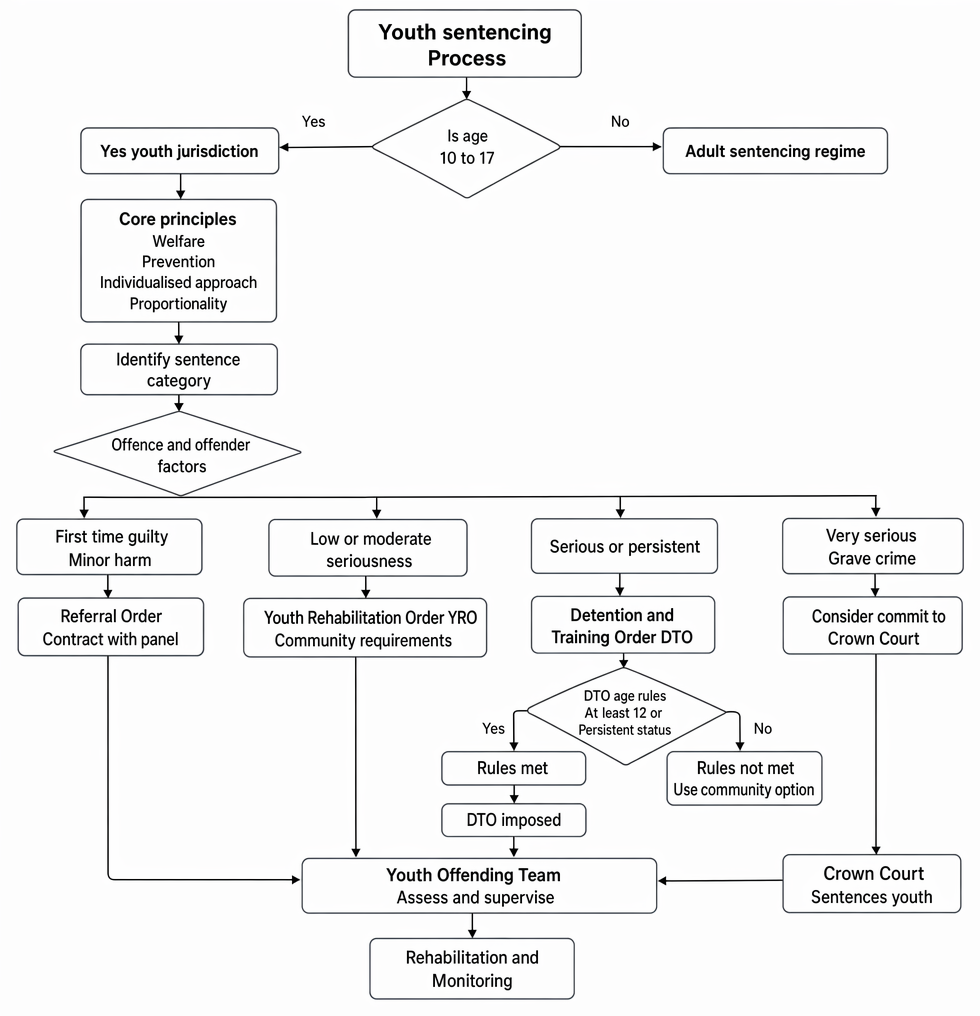
Youth sentencing procedure is organised by jurisdiction, core principles, offence seriousness, available disposals, DTO age rules, and Youth Offending Team supervision.
Test Tip: In SQE-style questions on Special considerations in youth sentencing, identify the legal test, the triggering fact, and the consequence before choosing between similar answer options.
Core Principles in Youth Sentencing
The youth justice system operates under the fundamental premise that children and young people are developing and have a greater capacity for change than adults. Sentencing decisions are therefore tailored to the individual, considering their age, maturity, capabilities, and personal circumstances alongside the seriousness of the offence.
Key Term: Welfare Principle
The principle, enshrined in s 44(1) of the Children and Young Persons Act 1933, requiring every court dealing with a child or young person to have regard to their welfare.
This principle mandates that any sentence imposed should aim not only to prevent reoffending but also to support the young person's well-being and inclusion in society.
Age of Criminal Responsibility
In England and Wales, the age of criminal responsibility is 10 years old. Children under 10 cannot be prosecuted for a criminal offence. For those aged 10–17, while they are held responsible, their age and level of maturity are significant factors in determining culpability and the appropriate sentence.
Sentencing Guidelines and Framework
The Sentencing Council provides specific guidelines for sentencing children and young people. These guidelines emphasize the importance of an individualized approach, focusing on:
- Seriousness of the offence: Assessing the harm caused and the young person's culpability, taking age and maturity into account.
- Likelihood of reoffending: Evaluating the risk factors associated with the young person and their circumstances.
- Welfare of the young person: Ensuring the sentence supports their well-being and addresses any fundamental needs (e.g., education, mental health).
Courts must consider pre-sentence reports, usually prepared by the Youth Offending Team (YOT), which provide detailed assessments of the young person.
Key Term: Youth Offending Team (YOT)
A multi-agency team responsible for coordinating youth justice services locally, including assessment, supervision, and delivery of interventions for young offenders.
The Sentencing Children and Young People Definitive Guideline requires courts to take a genuinely individualistic approach. Relevant youth-specific considerations include developmental and emotional maturity, neurodiversity or learning needs, looked-after status, exploitation, adverse childhood experiences, and the likely impact of any sentence on education, training, or accommodation. Custody is a last resort; the guideline directs courts to consider whether tailored community interventions can restrict liberty sufficiently and reduce reoffending. Reduction for a guilty plea applies, but in youth cases the primary emphasis remains on welfare and rehabilitation.
Revision Tip: YOT reports are essential in youth sentencing. They provide the court with detailed information about the young person's background, risks, needs, and suitability for different sentences. Pay attention to the role of YOTs in exam scenarios.
Youth Court Sentencing Options
The youth court (and the Crown Court when sentencing youths) has a range of specific disposals designed to meet the aims of the youth justice system. Custody is reserved as a measure of last resort.
Referral Orders
Referral Orders are typically used for first-time offenders who plead guilty to an offence punishable with imprisonment, provided the court is not imposing custody or an absolute discharge.
Key Term: Referral Order
A community-based sentence requiring a young offender to attend meetings with a Youth Offender Panel and agree to a contract aimed at repairing harm and preventing reoffending.
The order requires the young person to engage with a Youth Offender Panel (YOP) for a set period (between 3 and 12 months).
Key Term: Youth Offender Panel (YOP)
A panel, usually consisting of a YOT member and trained community volunteers, that works with the young offender and their family to agree a contract of rehabilitative and restorative activities.
The contract focuses on reparation to the victim or community and addresses the factors contributing to the offending behaviour. Failure to comply can lead to the youth being returned to court.
Referral Orders are mandatory for first-time guilty pleas to imprisonable offences unless the court imposes custody or an absolute/conditional discharge. If there are multiple charges with mixed pleas, the mandatory route only applies where guilty pleas cover all imprisonable offences. A further Referral Order can be made in exceptional circumstances where one has previously been imposed and worked constructively, but courts will often consider a YRO if needs persist. Breach of the Referral Order contract is brought back to court; the order can be extended or revoked with resentencing, and compensation orders may still accompany a Referral Order where appropriate.
Youth Rehabilitation Orders (YROs)
The YRO is a flexible community sentence that can combine various requirements tailored to the individual needs and risks of the young offender.
Key Term: Youth Rehabilitation Order (YRO)
A community sentence for young offenders that can include a range of requirements such as supervision, unpaid work, curfews, or participation in specific programmes.
A YRO can last for up to three years. Possible requirements include:
- Supervision by the YOT.
- Unpaid work (for those aged 16 or 17).
- Activity requirements (e.g., reparation, educational activities).
- Programme requirements (e.g., anger management, substance misuse programmes).
- Curfew requirements (often electronically monitored).
- Residence requirements.
- Mental health treatment requirements.
- Exclusion requirements from specified places or areas.
- Attendance centre requirements.
- Local authority residence or fostering (intensive fostering) where necessary.
Courts can also impose a YRO with Intensive Supervision and Surveillance (ISS) as a robust community alternative to custody for more serious offending. The ISS framework coordinates frequent contact, structured programmes, and reparation, with tracking to ensure compliance.
Key Term: Intensive Supervision and Surveillance (ISS)
A high-intensity package within a YRO combining close monitoring, frequent contact, structured interventions, and reparation, used as an alternative to custody in more serious cases.
The combination and intensity of requirements are determined based on the YOT's assessment and the seriousness of the offence. Requirements must be proportionate to the offence and realistic in light of the child’s circumstances; overly onerous packages that make breach likely should be avoided. Where breach occurs, courts may vary requirements, add conditions, or revoke and resentence. Repeated or wilful non-compliance can justify custody if the original offence crossed the custody threshold and community options have demonstrably failed.
Worked Example 1.1
Chloe, aged 16, pleads guilty to assault occasioning actual bodily harm. She has one previous youth caution for a minor public order offence. The court is considering a community sentence. The YOT report indicates Chloe struggles with anger management and has poor school attendance.
What requirements might a court plausibly include in a YRO for Chloe?
Answer:
The court could impose a YRO with requirements tailored to Chloe's needs. Plausible requirements might include:
- Supervision Requirement: Regular meetings with a YOT officer.
- Programme Requirement: Attendance at an anger management programme.
- Activity Requirement: Engaging in activities focused on improving school attendance or undertaking reparative work.
- Potentially an Unpaid Work Requirement (as she is 16), depending on the seriousness and circumstances.
- A Curfew Requirement might also be considered if offending occurred at night or to provide structure.
Worked Example 1.2
Zain, aged 17, is convicted of burglary of a dwelling. He has two prior findings of guilt for theft. The YOT assesses high risk of reoffending but good engagement when supervised. The offence crosses the custody threshold, but there is a credible community plan.
Should the court consider a YRO with ISS instead of custody?
Answer:
Yes. Where the offence is serious and custody is contemplated, a YRO with ISS can be an appropriate alternative if it can sufficiently restrict liberty and manage risk. For Zain, an ISS package with intensive supervision, daily structured activities, reparation, and electronic monitoring could be justified, provided compliance is realistic and the plan addresses criminogenic needs.
Detention and Training Orders (DTOs)
A DTO is a custodial sentence available for young offenders, typically reserved for serious or persistent offending where no other sentence is appropriate.
Key Term: Detention and Training Order (DTO)
A custodial sentence for young offenders comprising a period of detention in secure accommodation followed by a period of supervision in the community by the YOT.
The court must be satisfied that the offence(s) are so serious that only custody is justified. The available terms are fixed periods of 4, 6, 8, 10, 12, 18, or 24 months. Half the term is served in custody (usually a Secure Children's Home, Secure Training Centre, or Young Offender Institution) and the second half under YOT supervision in the community.
Specific age restrictions apply:
- A DTO cannot be imposed on 10 or 11-year-olds.
- For 12–14-year-olds, a DTO can only be imposed if the court deems them a 'persistent offender'.
Key Term: Persistent Offender
A term used in youth justice, generally meaning a young person who has repeatedly offended. There is no strict statutory definition; courts determine persistence based on offending history and frequency.
- For 15–17-year-olds, a DTO can be imposed without the need to establish persistence, provided the seriousness criteria are met.
Release from a DTO is on licence at the halfway point. Breach of licence conditions during the community period can result in recall to custody for part or all of the remaining term, depending on the nature of non-compliance. Where the youth court considers that a sentence substantially longer than 24 months is a realistic prospect (e.g., for grave crimes), the proper course is to send or commit to the Crown Court, as the youth court cannot exceed 24 months. Legal representation is required unless refused or withdrawn.
Worked Example 1.3
Liam, aged 14, is convicted after trial of robbery (a grave crime). He has two previous convictions for theft within the last 12 months, resulting in Referral Orders. The YOT report indicates a high risk of reoffending.
Can the youth court impose a DTO on Liam?
Answer:
Yes, the youth court could potentially impose a DTO. Robbery is a serious offence. Although Liam is only 14, a DTO is available if he is deemed a 'persistent offender'. Given his two recent relevant convictions, the court could reasonably classify him as persistent. The court would also need to be satisfied that the offence is so serious that only custody is appropriate. If these criteria are met, a DTO could be imposed for one of the specified periods (4–24 months). Alternatively, due to the gravity of robbery, the court might commit him to the Crown Court for sentence if it felt its own powers were insufficient.
Worked Example 1.4
Ruby, aged 16, is on a YRO with supervision, curfew, and programme requirements. She misses multiple appointments without reasonable excuse.
What are the likely consequences of her breach?
Answer:
Breach is brought back before the youth court. The court may:
- Find breach and vary the order by adding or intensifying requirements (e.g., adding exclusion or attendance centre).
- Revoke the YRO and resentence for the original offence, which can include custody if the offence crossed the custody threshold. Persistent or wilful non-compliance strengthens the case for custody where community options have been tried and failed.
Worked Example 1.5
Noah, aged 12, pleads guilty to a series of comparable shop thefts committed over several weeks. He has one prior finding of guilt six months ago.
Can Noah be treated as a persistent offender for the purposes of a DTO?
Answer:
Potentially, yes. Even in the absence of multiple prior findings, a single appearance for a series of separate comparable offences over a short period can justify classifying a child as persistent. The court must examine the nature and timing of the offences. If persistence is justified and the custody threshold is met, a DTO is available for a 12-year-old.
Grave Crimes
Certain serious offences, defined as 'grave crimes', have specific procedural implications for youths.
Key Term: Grave Crime
An indictable offence for which an adult aged 21 or over could be sentenced to 14 years' imprisonment or more (e.g., robbery, rape, s.18 GBH).
If a youth indicates a not guilty plea to a grave crime, the youth court must consider whether its maximum sentencing powers (a DTO of up to 24 months) would be adequate if the youth were convicted. If the court believes a sentence substantially longer than two years is a realistic possibility, it must send the youth to the Crown Court for trial. If the youth pleads guilty, or is convicted in the youth court but the court then considers its powers inadequate, it can commit the youth to the Crown Court for sentence.
Factors informing the “real prospect” test include the seriousness of the index offence, any aggravating features (e.g., weapon use, group offending, invasion of home), significant previous convictions, and any dangerousness concerns. Youth-specific mitigating factors (maturity, exploitation, welfare needs) must also be weighed before concluding that a sentence beyond two years is realistically in play.
Worked Example 1.6
Amara, aged 17, committed a s.18 GBH at age 17 but turns 18 before conviction. The YOT report identifies immaturity and a history of care placements.
Does crossing the age threshold change the sentencing approach?
Answer:
Crossing a significant age threshold between offence and sentence rarely justifies imposing a sentence more severe than would have been available when the offence was committed. The court will treat Amara as if still 17 for the purposes of youth sentencing considerations, focusing on immaturity and welfare, and will not allow turning 18 to lead to a more severe sentence than would have been available in youth court for the same conduct. If jurisdiction lies in the youth court, youth disposals remain available; where the Crown Court sentences, it applies youth-guideline principles to offence-date age and maturity.
Summary
- Youth sentencing prioritises preventing reoffending and the welfare of the young person.
- The age of criminal responsibility is 10. Age and maturity are key sentencing considerations.
- Sentencing guidelines and YOT reports inform individualised sentencing decisions.
- Referral Orders are common for first-time guilty pleas to imprisonable offences and are mandatory in many such cases; breach returns the matter to court.
- YROs offer flexible community-based requirements (e.g., supervision, programmes, curfew) for up to 3 years; ISS may be used as a custody alternative in serious cases.
- DTOs are custodial sentences (half in detention, half under supervision) for serious/persistent offending, with age restrictions (unavailable for under 12s; requires persistence for 12–14s). Maximum youth court DTO is 24 months; longer terms require Crown Court powers.
- Grave crimes may be sent/committed to the Crown Court if youth court sentencing powers are deemed insufficient, applying the “real prospect” test for sentences beyond two years.
- Crossing age thresholds between offence and sentence does not justify harsher outcomes; youth principles still apply.
Key Point Checklist
This article has covered the following key knowledge points:
- The principal aim of youth justice is preventing offending, with welfare as a primary consideration.
- The age of criminal responsibility is 10.
- Sentencing must be individualised, considering age, maturity, and circumstances.
- The Sentencing Children and Young People Definitive Guideline directs court decisions.
- YOTs play a key role through assessments and reports.
- Referral Orders involve a contract agreed with a Youth Offender Panel; they are mandatory for many first-time guilty pleas to imprisonable offences.
- Youth Rehabilitation Orders (YROs) are flexible community sentences; YROs can include ISS as an alternative to custody.
- Detention and Training Orders (DTOs) are custodial sentences used as a last resort for serious/persistent offending, with specific terms and age criteria; recall may follow breach of licence.
- 'Persistent offender' status is relevant for imposing DTOs on 12–14-year-olds.
- 'Grave crimes' may necessitate trial or sentencing in the Crown Court due to sentencing power limitations in the youth court.
- Crossing age thresholds does not justify more severe sentencing than was available when the offence was committed.
Key Terms and Concepts
- Welfare Principle
- Youth Offending Team (YOT)
- Referral Order
- Youth Offender Panel (YOP)
- Youth Rehabilitation Order (YRO)
- Intensive Supervision and Surveillance (ISS)
- Detention and Training Order (DTO)
- Persistent Offender
- Grave Crime