Learning Outcomes
This article outlines Detention and Training Orders (DTOs) in the context of youth court procedure, including:
- the statutory framework governing DTOs, covering eligibility criteria, fixed custodial terms, split custody/supervision structure, and available institutions
- the dual punitive and rehabilitative purposes of DTOs, and how welfare principles and legal safeguards restrict their use
- the custody threshold test for youth offenders and the requirement to exhaust community-based alternatives, especially intensive YROs
- the process for imposing a DTO, including pre-sentence reports, Youth Offending Team (YOT) input, and recording reasons for custody
- practical operation of the custody and supervision phases, YOT responsibilities during detention and release, and typical supervision requirements
- breach, enforcement, recall, and variation of supervision conditions, with emphasis on proportionality and ECHR-compliant decision-making
- distinctions between DTOs and other youth sentences such as Referral Orders and Youth Rehabilitation Orders, and their exam-relevant implications
- appeal and review routes for DTOs, including challenges to length, lawfulness, and procedural irregularities affecting validity of the order
- DTO suitability assessments, focusing on age, persistence, risk, proportionality, alternatives, and the critical role of effective legal representation
SQE1 Syllabus
For SQE1, you are required to understand Detention and Training Orders (DTOs) in youth court procedure, with a focus on the following syllabus points:
- the legal basis and statutory criteria for Detention and Training Orders (DTOs)
- the minimum and maximum custodial terms, and calculation of split custody and supervision periods
- eligibility requirements for different age groups, including concepts such as the persistent offender
- the custody threshold test and necessity for considering all community-based alternatives
- the process for obtaining and utilising pre-sentence reports, especially from YOTs
- the roles of the youth court and Crown Court in imposing and reviewing DTOs
- practical operation and purpose of DTOs, including the reintegration of young offenders
- key procedures for DTO breach, amendment, enforcement, and recall
- the rights of young people in custody, including ECHR compliance and the requirement for proportionality
- appeal routes, grounds, and procedural safeguards for DTOs
- differences between DTOs and other available youth sentences, including Referral Orders and Youth Rehabilitation Orders (YROs)
- the definition and importance of legal representation in custodial sentencing
Test Your Knowledge
Attempt these questions before reading this article. If you find some difficult or cannot remember the answers, look more closely at that area during your revision.
- What is the minimum and maximum length of a Detention and Training Order that can be imposed by a youth court?
- In what circumstances can a DTO be imposed on a 13-year-old?
- What are the two main phases of a DTO, and what happens during each?
- What must a court consider before imposing a DTO on a youth offender?
Introduction
Detention and Training Orders (DTOs) are the principal fixed-term custodial sentence available to youth courts in England and Wales for offenders aged 12 to 17. DTOs are designed not only to punish but also to rehabilitate young offenders through a period of secure detention followed by structured community-based supervision. DTOs are strictly regulated in law and practice to ensure compliance with the principles of proportionality, individual welfare, and the overall aim of preventing reoffending. Understanding the legal requirements, the custody threshold, and how DTOs interface with ECHR principles is fundamental for accurate advice and decision-making.
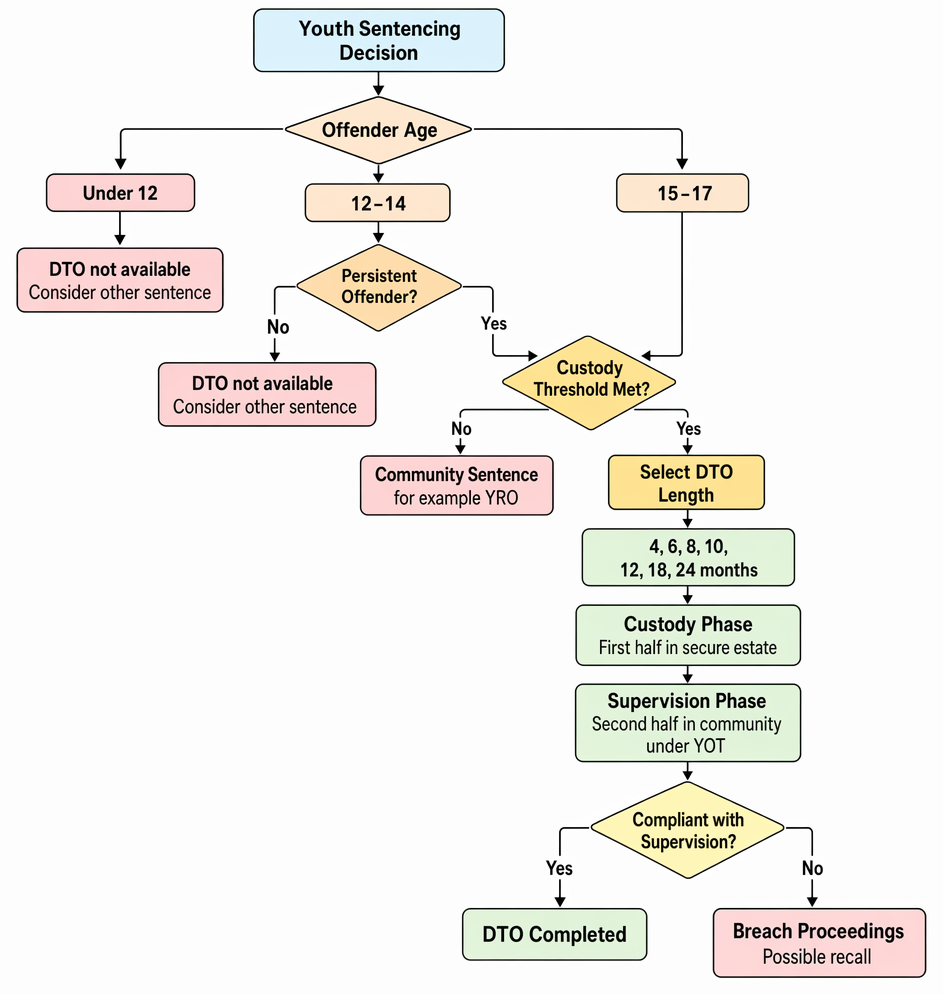
Detention and training order decision-making by age, persistent offending, custody threshold, term selection, custody and supervision phases, and breach proceedings.
Key Term: detention and training order (DTO)
A statutory custodial sentence for individuals aged 12–17. DTOs mandate a fixed period of detention in a secure facility, followed by supervised training and rehabilitation in the community, split equally between custody and the community phase.Test Tip: In SQE-style questions on Detention and training orders, identify the legal test, the triggering fact, and the consequence before choosing between similar answer options.
The Legal Framework for DTOs
DTOs are established under the Crime and Disorder Act 1998 and governed primarily by sections 100–107 of the Powers of Criminal Courts (Sentencing) Act 2000 (PCC(S)A 2000). These statutory provisions strictly dictate when and how a DTO can be imposed. The development of DTOs reflects a movement away from indeterminate youth detention towards a structure that combines restriction of liberty with the social aims of education, training, and reintegration. Importantly, the imposition and operation of DTOs must comply with the European Convention on Human Rights (ECHR), particularly Article 5 (right to liberty) and Article 6 (right to a fair trial), ensuring that deprivation of liberty is lawful, necessary, proportionate, and regularly reviewed.
Key Term: echr compliance
All custodial disposals for young people must comply with the ECHR, ensuring lawful, necessary, and proportionate deprivation of liberty, with appropriate legal safeguards.
Eligibility and Threshold for DTOs
DTOs may only be imposed if the sentencing court is satisfied that the offence is so serious that neither a fine nor a community sentence is justified. The principle that custody is a measure of last resort applies even more strongly to youth offenders than to adults, reflecting their vulnerability and developmental immaturity.
- Age: Only those aged 12–17 at the date of conviction are eligible.
- For those aged 12–14, the court can only impose a DTO if the individual is a “persistent offender.”
- DTOs are not available for children under 12; for those under 15, further restrictions apply.
Key Term: persistent offender
A youth who has a recent history of repeated offending, generally evidenced by two or more findings of guilt for imprisonable offences on separate occasions within the previous 12 months.
- Threshold: Referred to as the "custody threshold." Before a DTO is imposed, the court must be satisfied that the offence, alone or in combination with associated offences, is so serious that only a custodial sentence can be justified (PCC(S)A 2000, s. 100(2)).
Key Term: custody threshold (youth)
The statutory test requiring that a custodial sentence may only be imposed when the offence is so serious that neither a fine nor a community sentence is appropriate—even in cases of breach or repeat offending.
-
Alternatives: Before custody is imposed, all community-based alternatives—primarily Youth Rehabilitation Orders (YROs), including those with intensive supervision and surveillance (ISS)—must be fully considered and discounted as inadequate.
-
The court must provide clear, recorded reasons stating why a custodial order is justified and why alternatives are unsuitable.
-
Legal representation: A youth must have the opportunity to be legally represented in court if a DTO is being considered, barring exceptional circumstances, to satisfy both statutory requirements and ECHR compliance.
Key Term: legal representation
The right of a youth to have a solicitor or legal advisor assist in court, especially when custody is a possible outcome, to ensure fair process and protection of the youth’s rights.
- Pre-Sentence Report: No DTO can be made unless the court has obtained and considered a Pre-Sentence Report (PSR) from the Youth Offending Team (YOT) that specifically addresses the necessity and suitability of custody.
Key Term: pre-sentence report
A document prepared by the YOT that provides background, risk assessment, and advice to the court, including recommendations on custody and alternatives for a youth offender.
Worked Example 1.1
A 14-year-old convicted of burglary has two previous findings of guilt for theft within the last year. The YOT pre-sentence report recommends a YRO with intensive supervision. May the court impose a DTO?
Answer:
The youth is in the eligible age bracket and could be classified as a persistent offender. However, before imposing a DTO, the court must be convinced that the custody threshold is met and that a YRO with intensive supervision is insufficient. The court must give detailed reasons for rejecting the YOT recommendation, citing the seriousness of the burglary and previous failures to respond to community interventions.
Structure and Duration of DTOs
DTOs are for fixed, statutory periods: 4, 6, 8, 10, 12, 18, or 24 months. No other periods may be imposed. The period must reflect the seriousness of the offence and the youth's history, but must always be the shortest commensurate with the offence.
- Split Sentence Structure:
- Half in secure detention (Young Offender Institution, Secure Training Centre, or Secure Children’s Home)
- Half under supervision in the community
Key Term: proportionality
The principle that the length and nature of a DTO must be commensurate with the gravity of the offence and the youth’s individual circumstances.
The court must apply the principle of proportionality not only in deciding to impose a DTO but also in determining its length, in compliance with both domestic legislation and ECHR guidance.
-
Custody Phase: The initial half is served in a secure facility where the youth’s education and emotional needs are addressed. Provision must be made for:
- Accredited education and skills training
- Behavioural interventions
- Support for resettlement planning
-
Supervision Phase: The remainder is served in the community under the YOT's guidance, with compulsory compliance with supervision and reparation requirements.
- The precise nature of supervision will be determined by the YOT’s assessment of risk and needs (“scaled approach”).
- Conditions may include attendance at programmes, education, exclusion from specified areas, curfews, or requirements to avoid contact with certain individuals.
- The supervision is a necessary part of the DTO and failing to comply can lead to recall to detention.
Key Term: Youth Offending Team (YOT)
A multi-agency partnership responsible for the supervision, support, and rehabilitation of youth offenders in the community and for advising the court through pre-sentence reports and supervision arrangements.
- Facilities: The place of detention is decided according to the youth's age, gender, and assessed level of risk and vulnerability. The Secretary of State (via the Youth Custody Service) determines placement.
Worked Example 1.2
A 13-year-old classified as a persistent offender is sentenced to a 6-month DTO for robbery. How will the sentence be implemented?
Answer:
The order will total 6 months, split into 3 months in secure detention and 3 months in the community under YOT supervision. The YOT will develop a post-release action plan tailored to rehabilitate the youth, monitor compliance, and address factors linked to prior offending.
The Role of Pre-Sentence Reports
The pre-sentence report is central to both the eventual sentence and its justification. It must cover:
- Analysis of the offender’s previous behaviour and engagement with any prior interventions
- Risk of serious harm to the public or to themselves
- The likelihood of reoffending
- The suitability of custody versus community-based sentences
- Suggested programmes for rehabilitation
- Information regarding the youth's education, family background, and any safeguarding issues
The court is statutorily obliged to consider the PSR before imposing a DTO. A failure to do so will make any DTO unlawful and open to appellate challenge.
The Dual Purpose of DTOs
DTOs are distinguished from adult custodial sentences by their express twofold aim: punishment and training for rehabilitation. This duality is not secondary but necessary and reflected in the structure of the sentence.
- In detention, the focus is on addressing behaviour, education gaps, substance misuse where present, and developing positive social skills.
- In community supervision, efforts are made to reintegrate the offender, tackle the causes of offending, monitor risk, and support family and educational needs. The YOT will work closely with social care, education, and health services to provide bespoke support.
This ensures not only retributive justice but also long-term protection of the public by reducing reoffending.
Key Term: breach
Failure by the youth to comply with any requirement of the supervision portion of the DTO. Breach can result in sanctions, recall to custody, or amendment of supervisory requirements.
Worked Example 1.3
A 15-year-old released under the supervision phase refuses to attend mandatory YOT appointments on three occasions. What are the consequences?
Answer:
The breach is reported back to the court. The court may impose further conditions, extend the supervision requirements, or recall the youth to custody for some or all of the remaining supervision phase, ensuring proportionality and considering the individual’s best interests.
Breach and Enforcement
If a youth breaches a YOT supervision requirement during the community phase of a DTO, a formal breach process applies:
- The YOT will inform the court and lay the evidence for breach before a youth court bench.
- The court has discretion to order the youth to spend (typically) up to the remainder of the supervision phase in secure detention, amend existing requirements, or add additional measures.
- The court must comply with proportionality and ECHR requirements, ensuring measures are not excessive or punitive beyond necessity.
Special provisions exist for children who have changed address or are considered vulnerable. The possibility of recall is intended to be used in a measured and graduated way, considering the welfare and ultimate aim of rehabilitation.
Key Term: breach
When a youth does not comply with the requirements of their supervision order under a DTO, this non-compliance triggers a statutory response that may include recall to detention.Exam Warning: A DTO cannot be imposed solely because of repeated breaches of previous community sentences. The custody threshold must be met in relation to the instant offence, and the court must justify why alternatives would be inadequate. This ensures compliance with ECHR and national sentencing principles.
Appeals and Review
DTOs may be appealed to the Crown Court (if imposed by the youth court). An appeal may relate to:
- The imposition of the DTO (if the custody threshold was not properly applied, alternatives were not considered, or reasons were not given)
- The length or structure of the DTO (if it is manifestly excessive or disproportionate)
- Procedural irregularities (such as a failure to obtain a PSR, lack of legal representation, or the youth’s age or persistent offender status not being proved where required)
Proportionality is always the guiding principle on appeal. Also, review procedures allow for conditions to be amended in response to demonstrated compliance or to facilitate better reintegration.
Key Term: proportionality
All aspects of the court’s decision—imposing, structuring, and reviewing a DTO—must remain proportionate to the seriousness of the offending and in the best interests of the youth.
Legal representation is necessary throughout DTO proceedings, encompassing advice on evidence, explanation of conditions, and proper advocacy at sentencing and review hearings.
Key Term: legal representation
The provision of representation by a qualified solicitor or legal adviser to ensure the youth understands proceedings, their rights are protected, and advocacy is provided throughout the process.
Comparison with Other Sentences
It is essential to distinguish DTOs from other youth sentences.
- Referral Orders are mandatory for first-time youth offenders who plead guilty to an imprisonable offence (unless a custodial sentence is imposed or an absolute/conditional discharge is considered more appropriate). Referral Orders are wholly community based and are overseen by a Youth Offender Panel convened by the YOT.
- Youth Rehabilitation Orders (YROs) are flexible community sentences combining multiple requirements—curfew, supervision, attendance centre, exclusion, etc.—and in some cases can include ISS or extended activity, coming close to a custodial order but still served in the community. ISS is typically the most rigorous YRO alternative to custody.
- DTOs are reserved for those cases where all community alternatives have been deemed insufficient and where immediate custody is necessary and proportionate.
Key Term: pre-sentence report
A structured report by the YOT, providing the court with detailed information about the youth’s background, risk factors, previous sentences, engagement, and the suitability of various disposals, forming a necessary part of the sentencing decision.
Worked Example 1.4
A 16-year-old, with previous unsuccessful YRO (ISS) for repeated violent offences, has committed a knife-point robbery. The pre-sentence report details failure on ISS, escalating seriousness, and significant risk currently posed to the public. What must the court consider before a DTO?
Answer:
The court must still apply the custody threshold, consider the welfare and specific circumstances of the youth, and fully discount YRO (ISS) as inadequate before imposing a DTO. The pre-sentence report must be examined carefully, and the court must provide detailed reasons for imposing custody.
Summary
| Feature | DTOs (Detention and Training Orders) |
|---|---|
| Age range | 12–17 (12–14 only if persistent offender) |
| Length | 4, 6, 8, 10, 12, 18, or 24 months |
| Structure | Half custody, half community supervision |
| Threshold | Only if offence is so serious custody justified |
| Alternatives | Must consider YRO with intensive supervision |
| Breach | May result in return to court/custody |
Key Point Checklist
This article has covered the following key knowledge points:
- A Detention and Training Order is a statutory custodial sentence for offenders aged 12–17, divided into equal custody and community supervision phases.
- The custody threshold for DTOs requires that no alternative is suitable, and full reasons must be provided if custody is imposed.
- For those aged 12–14, DTOs can be imposed only if the youth is a persistent offender.
- Before passing a DTO, the youth court must obtain a pre-sentence report from the YOT and ensure the youth is legally represented.
- DTOs have fixed statutory lengths and cannot exceed 24 months in youth court.
- Release from custody to supervision is necessary for rehabilitation and is closely managed by the YOT, with recall powers for breach.
- Court decisions must always be proportionate and ECHR-compliant, with explicit consideration given to the impact of custody.
- Effective legal representation and proper use of pre-sentence reports are necessary safeguards before the imposition of a DTO.
- Appeals and reviews may address the imposition and length of DTOs, particularly if there has been a failure to properly apply the threshold test or procedural irregularities arise.
- DTOs are distinct from Referral Orders and YROs, which are non-custodial and serve as alternatives unless all have failed or are inadequate for the current offence.
Key Terms and Concepts
- detention and training order (DTO)
- custody threshold (youth)
- persistent offender
- Youth Offending Team (YOT)
- proportionality
- echr compliance
- legal representation
- pre-sentence report
- breach