Learning Outcomes
This article explains how to apply time value of money concepts to capital budgeting problems tested on the CFA Level 1 exam. It develops the procedures for calculating net present value (NPV) and internal rate of return (IRR) for single-project cash-flow patterns, interpreting the resulting figures, and stating the appropriate accept-or-reject decision based on a given required rate of return. The article shows how to translate word-based investment scenarios into cash-flow timelines, select suitable discount rates, and distinguish between project operating cash flows and financing flows. It also explains how NPV and IRR incorporate the time value of money, compares their respective advantages and limitations, and highlights why NPV should dominate when the two methods give conflicting signals. In addition, it clarifies how multiple sign changes in cash flows can lead to multiple IRRs, when to rely on NPV instead, and how reinvestment assumptions differ across methods. Throughout, the focus remains on calculator-efficient techniques, recognition of common exam traps, and concise, exam-style reasoning that aligns with CFA Level 1 learning objectives.
CFA Level 1 Syllabus
For the CFA Level 1 exam, you are expected to understand the main principles and calculation steps of project appraisal, with a focus on the following syllabus points:
- Explaining the time value of money as the basis for comparing cash flows across time
- Calculating the net present value (NPV) and internal rate of return (IRR) for individual capital investments
- Interpreting and applying the NPV and IRR decision rules to assess investment projects
- Recognizing cash flow timing, sign changes, and reinvestment assumptions in IRR calculations
- Comparing advantages and limitations of NPV and IRR for capital allocation decisions
Test Your Knowledge
Attempt these questions before reading this article. If you find some difficult or cannot remember the answers, look more closely at that area during your revision.
- Which statement describes the NPV rule for capital investments?
- What does the IRR represent in a project appraisal context?
- Can the project with the highest IRR always be chosen over one with the highest NPV? Why or why not?
- If a project’s NPV is zero at the company’s required return, what should management decide?
Introduction
Time value of money is the basis for evaluating investment projects in finance. Capital budgeting decisions—for example, whether to invest in a new facility or launch a new product—require comparing cash flows that occur at different points in time. Discounting future cash flows to their present values enables companies to assess whether a project creates value.
Two primary metrics are used at CFA Level 1 to analyze individual investments:
- Net Present Value (NPV): The present value of expected future cash inflows minus cash outflows, using an appropriate discount rate.
- Internal Rate of Return (IRR): The discount rate at which NPV is zero, representing the project’s expected rate of return on invested capital.
This article reviews NPV and IRR, including formulas, calculation steps, decision rules, interpretation, and CFA exam-relevant limitations.
Key Term: time value of money
The principle that a sum of money today is worth more than an identical sum in the future, due to its earning potential and opportunity cost. Key Term: net present value (NPV)
The sum of the present values of all cash inflows and outflows associated with an investment, discounted at the required rate of return. Key Term: internal rate of return (IRR)
The discount rate that makes the net present value (NPV) of all cash flows from a particular project equal to zero.
Net Present Value (NPV) Fundamentals
NPV answers the question: By undertaking this project, how much value (in today’s currency) is added to the business? It is calculated by discounting each expected cash flow back to the present using the required rate of return (the hurdle rate or cost of capital).
NPV Formula:
Where:
- = cash flow at period
- = required rate of return
- = number of periods
NPV Decision Rule:
- Accept the project if NPV > 0. The project increases firm value.
- Reject the project if NPV < 0. The project destroys value.
Key Term: required rate of return
The minimum return a project must achieve to be worth investing in, typically reflecting investors’ opportunity cost and the project's risk.
Internal Rate of Return (IRR) Basics
IRR is the discount rate that sets the sum of discounted cash flows (NPV) to zero. In effect, it is the break-even return for the project, or the compound annual rate of return the project is expected to generate.
IRR Formula: Set and solve for :
IRR Decision Rule:
- Accept the project if IRR ≥ required rate of return (hurdle rate).
- Reject if IRR < required rate of return.
IRR is commonly solved using a financial calculator, spreadsheet, or trial and error, as there is generally no closed-form solution when cash flows vary in amount and timing.
Why Use Present Value Methods
Comparing sums across time requires discounting. Money in the future must be discounted to its present value using a rate reflecting the opportunity cost.
For example, $1,000 received two years from now is worth less than $1,000 today because you could invest today's sum to earn interest. All NPV and IRR calculations use the time value of money principle to bring future cash flows to present value.
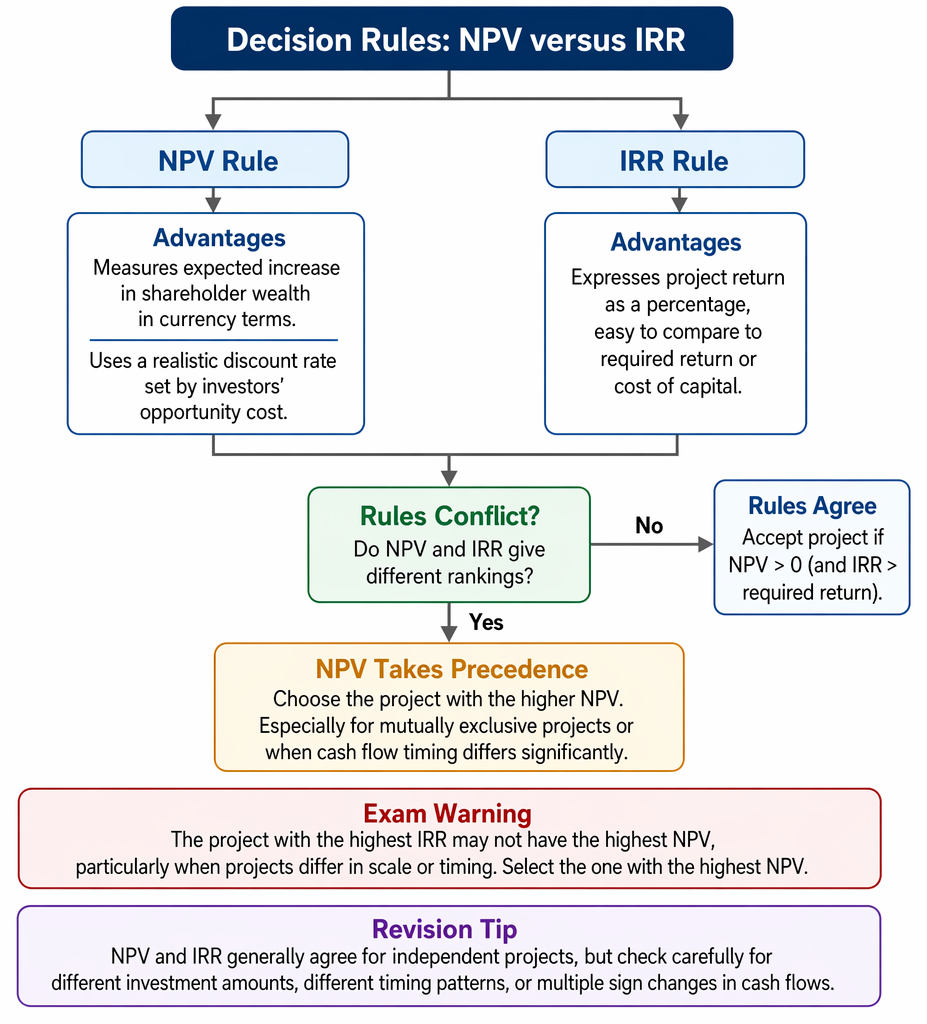
Decision Rules: NPV versus IRR
NPV Rule Advantages:
Net present value combines CFt, required return r, and project life N in a present value sum under the positive-NPV criterion.
- Measures expected increase in shareholder wealth in currency terms.
- Uses a realistic discount rate set by investors’ opportunity cost.
IRR Rule Advantages:
- Expresses project return as a percentage, which is easy to compare to required return or cost of capital.
Which rule takes precedence if the rules conflict? NPV takes precedence for decision-making, especially when projects are mutually exclusive or cash flow timing differs significantly.
Worked Example 1.1
Question: A company considers investing $100,000 today in a project generating $30,000/year for five years. The required return is 8%. Should management accept the project?
Answer:
Calculate NPV:
NPV is positive ($19,786). The project should be accepted.
Worked Example 1.2
Using the same project, what is the IRR? Is it above the required return?
Answer:
Set NPV = 0 and solve for IRR:
Use a spreadsheet/calculator: IRR ≈ 13.4% IRR exceeds the required return of 8%, so the project is acceptable.
Exam Warning: The project with the highest IRR may not always be the one with the highest NPV, especially for mutually exclusive projects with different scales or timing of cash flows. You must select the one with the highest NPV for exam questions that specify only one project can be chosen.
Revision Tip: NPV and IRR generally agree for independent projects, but always check exam questions carefully for projects with different investment amounts, different timing patterns, or multiple sign changes in cash flows.
Limitations of NPV and IRR
- IRR assumes reinvestment of interim cash flows at IRR, while NPV assumes reinvestment at the required rate of return.
- Projects with non-normal cash flows (i.e., multiple sign changes in cash flows) can result in multiple IRRs.
- IRR does not measure wealth created in currency terms; NPV does.
Worked Example 1.3
Question: A project requires an outlay of $1,000 today, returns $5,000 next year, and calls for an additional investment of $6,000 in year 2. What is the IRR?
Answer:
Cash flows: Year 0 = -1,000, Year 1 = +5,000, Year 2 = -6,000 The equation has two IRRs:
Try IRR = 100%:
Try IRR = 200%:
Conclusion: Multiple IRRs exist—NPV should be used for decision making in such cases.
Exam Warning (Multiple IRRs)
Do not rely on IRR alone when cash flows change sign more than once. Use NPV for project selection.
Summary
NPV and IRR are fundamental tools for CFA candidates to appraise investment projects. NPV directly measures value created in currency terms, aligned with shareholder wealth maximization. IRR indicates the break-even project return as a percentage, but in cases of conflict, the NPV rule prevails. Correct application of these rules is essential for CFA exam success.
Key Point Checklist
This article has covered the following key knowledge points:
- Explain time value of money and its role in project appraisal
- Calculate NPV and interpret its decision rule
- Determine IRR and apply the IRR decision rule
- Recognize situations when NPV and IRR may conflict
- Know why NPV takes precedence for mutually exclusive projects or non-normal cash flows
Key Terms and Concepts
- time value of money
- net present value (NPV)
- internal rate of return (IRR)
- required rate of return